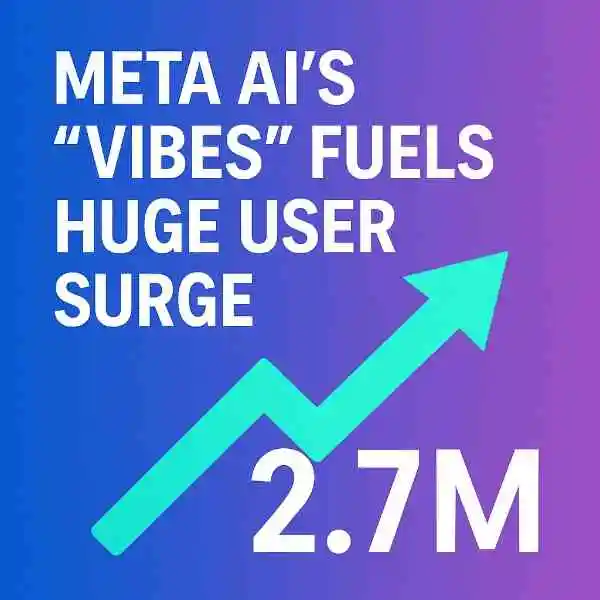
Meta’s AI mobile app is seeing a steep acceleration in usage following the launch of “Vibes,” a new short-form AI-video feed introduced in late September — and the shift is now reshaping competitive positioning in consumer AI, app-store attention cycles, and early product-market signals.
Daily active users on Meta AI for iOS and Android have reached a combined 2.7 million as of October 17, according to Similarweb data reviewed by Reuters. That is up from roughly 775,000 four weeks earlier, representing a user acceleration rarely seen in the AI consumer apps category without a major celebrity, safety or geopolitical news cycle attached.
INSTALL VELOCITY UP — AND IT’S NOT A SPIKE BASED ON MARKETING ALONE
Meta AI is now adding about 300,000 new installs per day, Similarweb estimates. A month earlier, that number was under 200,000. Exactly one year earlier — October 2024 — the app averaged roughly 4,000 installs a day.
These jumps do not map to sudden paid search shifts, nor to corresponding swings on the display or app-store side, according to Similarweb’s marketing signal scraping. If Meta is running intra-Meta promotions on Facebook, Instagram or WhatsApp surfaces, those campaigns are not leaking into the typical attribution models.
VIBES IS THE PLAUSIBLE ACCELERATOR
The timing fits. Meta launched Vibes — a short-format algorithmic feed of AI-generated video — on September 25. The daily user line breaks upward that same week. In previous cycles, Meta AI usage behaved as a background chat utility. Vibes appears to have recast the app as an entertainment layer, not a utility layer.
This distinction matters: people are not just coming back to talk to a model. They are scrolling.
SORA CREATED DEMAND THAT META CAUGHT
This acceleration is not happening in a vacuum — and not purely because Meta changed its own product. OpenAI’s Sora hit the App Store at the exact moment consumer video models peaked in cultural attention. People rushed to try Sora. Many could not. Sora remained invite-gated.
Meta AI — with Vibes — became the nearest open path.
If even 10%, 5% or 2% of Sora-interested users failed to get in, those users would have frictionlessly been absorbed by Meta’s app — because Meta is everywhere already.
MARKET SHARE IN THE AI CONSUMER APP CATEGORY
As Meta AI daily users rose ~15.6% globally the week of October 17, Similarweb’s comparative panel shows day-over-day declines in three reference peers:
- ChatGPT: down ~3.5%
- Grok: down ~7.3%
- Perplexity: down ~2.3%
This does not indicate a collapse. It indicates an attention reallocation.
The category is taste-based mood cycles. The dominant commodity is minutes.
Meta’s Vibes changed the minute-allocation equation.
WHAT THIS SIGNALS FOR THE NEXT QUARTER
If Vibes retention holds, Meta has demonstrated a new strategic wedge: short-form AI video as an engagement fulcrum.
Video = emotion
Emotion = habit
Habit = return frequency
Chat alone has weak habit gravity.
AI video has stronger gravity — because entertainment is a higher frequency behaviour than information retrieval.
META vs OPENAI: STRATEGY DIVERGENCE IS NOW MATERIAL
Meta’s Vibes-driven surge underscores a strategic gap between the two largest narrative centers in consumer AI: Meta is leaning into distribution first, while OpenAI is prioritizing scarcity, gating and controlled rollouts.
Meta’s bet: scale.
OpenAI’s bet: curation.
These are not philosophical differences — they are business model differences. Meta wants to win on volume. OpenAI wants to win on premium.
OPENAI IS PLAYING A “LUXURY MODEL” STRATEGY
OpenAI’s choice to gate Sora — the most culturally potent model it has released — is consistent with the company’s pattern of sequencing:
- release teaser content
- restrict access
- admit a small tranche of users
- study usage + safety risk
- expand selectively
This keeps supply low, keeps buzz high, and concentrates the user base into power users with high purchase probability for downstream enterprise products.
META IS PLAYING A “GLOBAL TV NETWORK” STRATEGY
Meta is acting like a global broadcast operator, not a lab. Their mission is not to make the most powerful model — their mission is to create the biggest audience.
Video is scalable audience.
By seeding AI video in a TikTok-native format (short-form vertical), Meta is treating AI as content, not as capability — and content scales instantly across billions of existing surfaces.
TWO PARADIGMS ARE COLLIDING
OpenAI builds scarce premium cinematic video tools.
Meta builds infinite scroll AI video feeds.
One is prestige cinema.
One is infinite television.
These orientations will define the next 18 months of the consumer AI wars.
Because the market will not reward model power — the market will reward daily minutes captured.
THIS IS WHERE META’S GAMBLE IS DANGEROUSLY SMART
Meta understands something Silicon Valley pretends not to understand:
most of the world does not want to “use AI” — most of the world wants to be entertained.
If AI is delivered as entertainment, AI becomes culturally default and frictionless.
OpenAI still treats AI as a tool.
Meta is now treating AI as culture.
IF YOUTUBE SHORTS AND TIKTOK COPY THIS
If AI-generated short video proves habit-forming, the natural response from incumbent platforms will be rapid imitation.
YouTube and TikTok have structural advantages: enormous creator bases, existing recommendation engines, and established ad ecosystems.
TikTok’s algorithm already optimizes for discovery and virality; adding synthetic clips to the supply mix could be a marginal change in tooling but a major change in volume.
TikTok could launch an “AI Clips” layer that blends creator content with model-generated clips, preserving creator opportunity while expanding watch time.
YouTube has a different lever: monetization sophistication.
YouTube could seed synthetic previews, auto-generated shorts from long-form catalog content, and hybrid clips that repurpose licensed media into new snippets.
Both platforms face a trade-off.
Integrating synthetic content at scale risks degrading creator earnings, diluting brand authenticity, and triggering legal complications over likeness and rights.
Creators will pressure platforms for revenue protection.
If platforms flood feeds with machine-made content, creators may demand higher rev-share, minimum guarantees, or exclusive protections for human-origin videos.
A second risk for incumbents is reputational: audiences may reject feeds that feel “too synthetic” or low-quality.
Sustaining long-term engagement requires synthetic output to meet evolving taste — not just quantity.
The short-term playbook for incumbents is straightforward: experiment fast, measure retention, and offer creator safeguards.
If retention lifts materially, expect immediate product launches and heavy experimentation from both TikTok and YouTube.
Regulation will complicate rapid copying.
Platforms that prioritize scale will draw scrutiny over deepfakes, copyright, and misinformation vectors, forcing simultaneous investments in detection and moderation.
Ultimately, the winner in this defensive phase may be the platform that manages the creator-economics balance while delivering synthetic quality that audiences accept as enjoyable.
That is a narrow technical and political path, but it is achievable for well-resourced incumbents.
MONETIZATION MATH: CAN VIBES PAY FOR ITSELF?
Attention is necessary but not sufficient; the survival test for any feed is monetization.
Meta’s core revenue engine is advertising — and that map scales differently for synthetic content.
Ad load in short-form video is already compressed; brands tolerate fewer interruptions and prefer native integrations.
Synthetic clips can be tailored for formats that increase completion rates, but they also risk trivializing ad placement if viewers view content as less valuable.
One direct monetization route is native sponsorships integrated into synthetic narratives.
AI can generate branded micro-stories or product placements with high relevance to viewer signals, potentially improving ad targeting and recall.
Another route is creator hybridization: paid amplification for human creators who partner with AI for higher production cadence.
This could create a payable “studio-as-service” model where creators pay for synthetic assets that amplify reach.
Subscription layers are possible but challenging at scale.
While a fraction of superfans may pay for exclusives or ad-free AI channels, mass adoption of paid feeds is unproven in short-form verticals.
There is also commerce: shoppable AI clips could be an immediate revenue lever.
If an AI Vibe showcases a product, the platform can surface a buy button within the clip and take a cut — effectively turning entertainment into direct commerce.
From a cost perspective, generating video at scale has CPU and storage costs that are non-trivial.
Inference costs for high-fidelity video and the storage of user-facing artifacts will compress margins unless generative pipelines are drastically optimized.
Meta has an advantage: first-party data.
Better user signals mean better ad targeting and higher CPMs. If Vibes increases session length, even modest uplift in CPMs can translate into substantial revenue growth.
However, advertiser acceptance is not guaranteed.
Brands may hesitate to appear next to fully synthetic environments until safety and brand suitability frameworks are proven.
Finally, the macro backstop: if Vibes drives meaningful incremental minutes, the long-term monetization win is plausible.
But converting that attention into sustainable, profitable revenue requires careful product design, brand partnerships, ads engineering, and meaningful cost reduction in generation.
WHY THIS MATTERS FOR GLOBAL MARKETS (PAKISTAN, INDIA, GCC, SEA)
AI entertainment is not a U.S.-only phenomenon; global audience dynamics will determine long-run winners.
Countries with large mobile-first populations and short-form habits are poised to adopt synthetic feeds rapidly.
India and Pakistan have enormous short-video audiences with low per-user ARPU today.
For platforms, synthetic video can increase session length and open new commercial experiments — but local monetization will be constrained by purchasing power and ad market maturity.
In India, a hybrid model is likely: AI clips mixed with creator content, localized language generation, and strong partnerships with regional studios.
Regulatory focus on content moderation and political sensitivity will force stricter guardrails than in Western markets.
Pakistan’s market is smaller but culturally aligned with mobile short-form consumption.
Localized Vibes in Urdu and Punjabi, with region-specific themes, could accelerate adoption faster than in markets dominated by English-language content.
The Gulf (GCC) region presents a higher-ARPU testbed.
Advertisers in the GCC may adopt immersive synthetic formats sooner, enabling premium brand partnerships and commerce experiments that subsidize broader global rollout.
Southeast Asia is a tipping point region.
Large populations, high engagement, and growing e-commerce integration make SEA fertile ground for shoppable AI clips that link entertainment to conversions.
However, infrastructure and device fragmentation matter.
High-fidelity synthetic video needs decent network capacity and modern phones; markets with older hardware or limited bandwidth will require lighter-weight generation (lower fps, stylized renderings) to be practical.
Language is both opportunity and barrier.
High-quality localized voice, culturally coherent narratives, and appropriate humor are necessary for mass adoption. Generic English-only synthetic feeds will underperform outside anglophone markets.
Regulation differs widely.
EU-style content rules, India’s intermediary liability laws, and Pakistan’s content controls will shape feature design and moderation investment.
Platforms must localize not only content but compliance frameworks.
Finally, cultural taste is unpredictable.
Some markets prize authenticity and may resist fully synthetic celebrity-like figures, while others will embrace novelty.
A successful global rollout will require regional product teams, local partnerships, and rapid iteration informed by analytics and cultural counsel.
MODERATION AND SAFETY IMPLICATIONS
AI-generated video raises new moderation challenges that are both technical and legal.
Unlike text or static images, video combines motion, audio, and likeness, increasing the risk of realistic deepfakes and harmful manipulation.
Platforms will need multilayered defenses: provenance metadata, real-time detection models, user reporting pipelines, and human review for high-risk content.
Provenance—signed claims about who created the media and what model produced it—may become a baseline requirement for platform trust.
Scale makes moderation harder.
When millions of clips are generated daily, automated filters will carry the burden; false positives and negatives will rise, with real-world consequences for speech and safety.
Audio and voice cloning add a second vector.
Synthetic video paired with cloned voices can replicate public figures, propagate misinformation, and create believable fraud attempts at scale.
Child safety is a specific concern.
AI-generated scenes involving minors — even fabricated — risk exploitation and legal liability; platforms must hard-code protections and deny generation requests that touch on vulnerable populations.
Content moderation will also intersect with copyright and image rights.
If models draw on protected cinematic or musical material, the platform could face complex takedown and licensing claims across jurisdictions.
Transparency will be a competitive advantage.
Platforms that expose clear provenance, offer appeal processes, and publish transparency reports will gain advertiser and regulator trust faster than opaque systems.
CREATOR ECONOMY: THREAT, TOOL, OR PARTNER?
The creator economy faces a paradox: AI can both displace creators and empower them.
Synthetic clips could reduce production time, lower costs, and enable solo creators to produce “studio-scale” pieces—but also flood feeds with machine-made alternatives.
Creators may respond in several ways.
Some will embrace AI as a co-creator, using synthetic assets to increase output and monetize through branded partnerships. Others will use authenticity as a premium differentiator, charging for human-made exclusives.
Platforms will need new contractual models.
Revenue share arrangements may evolve to include AI-asset licensing fees, guarantees for human-origin content, or tiers that reward experimental human-AI collaborations.
A legal fight is likely around likeness and voice rights.
Artists and influencers will demand control over whether AI can replicate their style, face, or voice; platforms will need explicit opt-ins and takedown mechanics.
For ecosystem health, hybrid models are plausible: paid boosts for creator-AI hybrids, studio-as-a-service tools for pros, and creator protection programs to offset displacement risks.
Platforms that engineer these hybrids can preserve creator goodwill while scaling synthetic supply.
Ultimately, the creator class will remain valuable if platforms can keep human stories and relatability at the center.
Creators who pivot to higher-order roles—curation, persona-building, community management—can retain leverage even if production becomes automated.
TECHNICAL SUPPLY CHAIN AND COSTS
Generating billions of short videos is not free.
High-fidelity video inference requires significant GPU/TPU compute, bandwidth, and storage; operational costs could be large unless architecture is optimized.
Model efficiency improvements will be decisive.
Techniques such as temporal compression, latent-space rendering, and multi-modal distillation can reduce per-clip compute while retaining perceptual quality.
Edge generation is a potential cost-saver, but device limitations matter.
Offloading light-weight stylized clips to phones can reduce server load, but only if models are compact enough and networks handle reduced latency reliably.
Storage and cataloging also scale non-linearly.
Retention policies—how long generated clips are stored, who can re-request them, and what derivatives are kept—will materially affect costs and compliance obligations.
Inference caching and adaptive bitrate strategies can lower billable compute.
If many users request similar themes, caching generated variations and recombining assets reduces redundant inference.
Energy and sustainability concerns will surface.
Large-scale generative video farms will attract scrutiny for carbon footprint; platforms may need to disclose energy use, optimize for efficiency, or buy offsets to maintain public trust.
Monetization must outpace cost per minute.
If the marginal cost to generate a minute of watchable synthetic content exceeds the marginal revenue per minute, the model is economically unsustainable.
Tech stack competition is already emerging: silicon vendors, inference-as-a-service providers, and model optimization firms will capture value.
Platform strategy must include long-term supply agreements and edge partnerships to manage unit economics.
REGULATORY AND POLICY RISKS
Regulation will be the third rail for synthetic video.
Policymakers are already considering rules for deepfakes, political advertising, and AI transparency—short-form AI video accelerates urgency.
Different jurisdictions will diverge.
The EU is moving toward strict AI liability and transparency regimes; the US is fragmented but increasingly focused on disinformation and consumer harm; countries in Asia and the Middle East emphasize content control and local cultural norms.
Political advertising rules create near-term complexity.
If AI clips are used to fabricate endorsements or manipulate political narratives, platforms could face bans, fines, or pre-publication review requirements in sensitive markets.
Platforms operating globally must build configurable compliance layers.
Feature flags—switching off certain generation types in specific countries, geofencing, and localized content filters—will be operational necessities.
Auditability will be required.
Regulators will push for access to models’ training provenance, filtering logs, and moderation outcomes—introducing potential IP and privacy tensions.
Liability allocation is unresolved.
Is the platform liable for harm caused by a generated clip, or the model owner, or the end-user who prompted it? Legal frameworks will likely evolve in litigation, not legislation.
Preemptive policy engagement will help.
Platforms that co-design soft law with governments, fund independent audits, and invest in safety labs will reduce regulatory shocks.
CULTURAL AND ETHICAL QUESTIONS
Synthetic entertainment also raises cultural questions about taste, authenticity, and labor.
Audiences may tire of synthetic novelty if it lacks cultural grounding, nuance, or emotional authenticity.
Ethical norms around representation and bias carry over to generated media.
Biases in training data can produce stereotyped or exclusionary content; platforms must audit models for cultural safety.
There are moral questions around replacing human storytellers.
Is a film written and performed by AI a legitimate cultural artifact? Who gets credit? Who owns the copyright?
Cultural institutions—film schools, guilds, and festivals—will weigh in, shaping norms and possibly erecting barriers to synthetic content recognition.
Public debate will determine social license.
Platforms that assume purely technical fixes risk backlash; those that include cultural stakeholders will have better odds of long-term acceptance.
WHAT COMES NEXT
We are at an inflection.
If AI-generated video sustains retention and satisfies quality expectations, the entertainment landscape will reorder.
Platforms will iterate fast.
Expect rapid A/B testing, creator protection experiments, and regional rollouts with tailored moderation stacks.
Regulators will respond.
Expect proposed laws on transparency, provenance, and liability to appear in major markets within 12–24 months.
Creators will adapt.
Some will monetize novel hybrid forms; others will litigate or lobby for protections.
And consumers will decide.
If audiences find synthetic clips enjoyable, fast, and affordable, the balance of cultural production will tilt toward machine-made content at scale.
Conclusion
Meta’s “Vibes” moment is not a temporary spike — it is a signal that the AI industry has entered its first true format transition. Models were never going to take AI mainstream by asking billions of people to type clever prompts. Consumers do not change behavior to suit models. Platforms must change interfaces to match the way billions already behave. Meta understood that short video is the world’s default entertainment language, and simply attached AI to that language. The result: the only AI platform currently rising is the one that stopped forcing its users to think — and simply let them scroll. The future of the AI market will be won not by bigger parameters or benchmark PDFs, but by whoever controls the feed where people spend the most time.