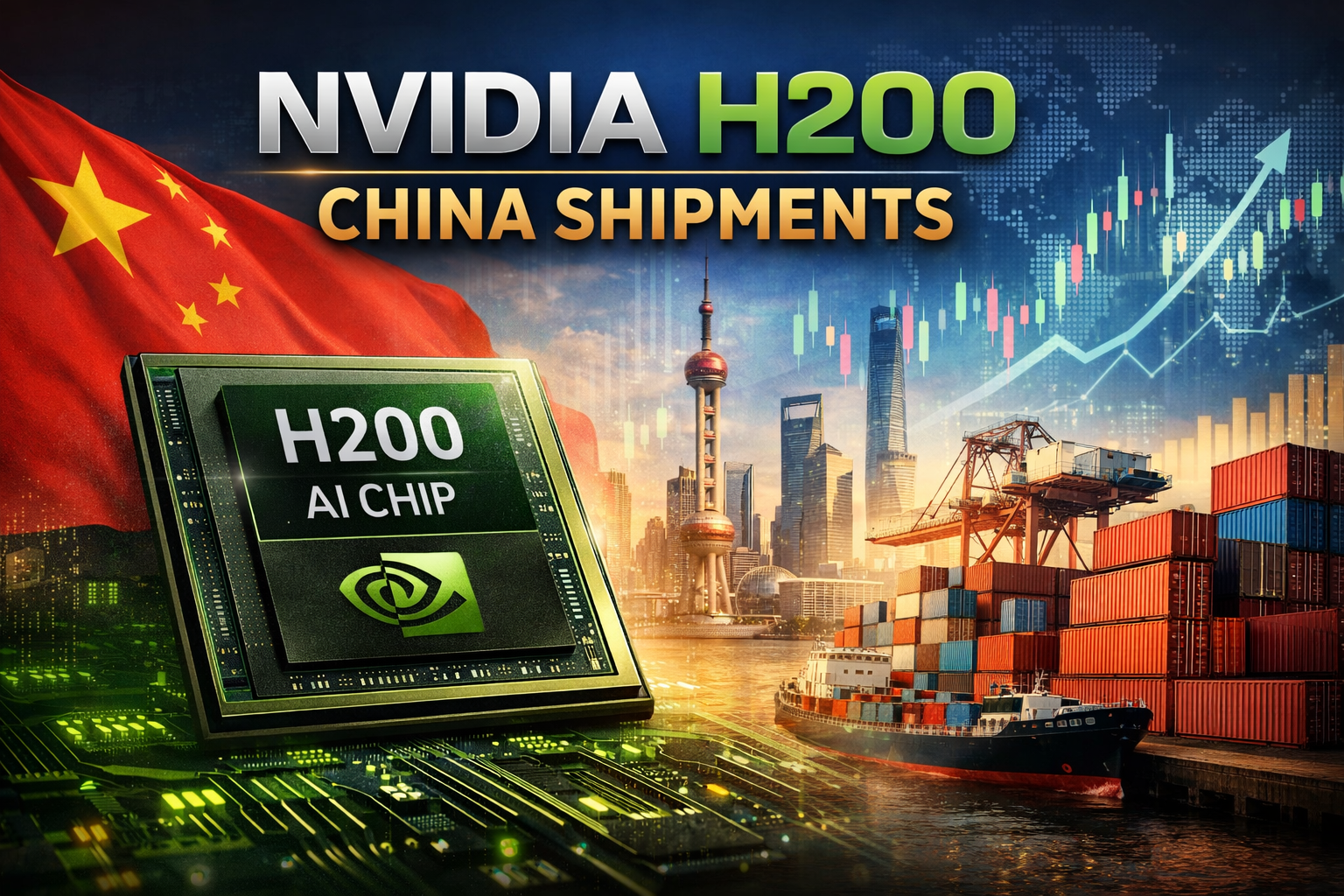
Nvidia (NASDAQ: NVDA) is gradually positioning itself for a potential return to the Chinese market by preparing limited shipments of its H200 artificial intelligence chips. This move reflects a cautious strategy shaped by regulatory oversight, geopolitical constraints, and sustained demand for advanced AI computing hardware in one of the world’s largest technology markets.
Rather than signaling a full-scale re-entry, Nvidia’s approach suggests a trial phase—designed to test approval pathways, logistics, and customer demand without committing significant new manufacturing resources upfront.
Initial Shipments and Strategic Testing
Nvidia plans to begin by shipping H200 chips from existing inventory rather than expanding production immediately. Early estimates indicate that between 5,000 and 10,000 chip modules could be delivered in the initial phase, representing roughly 40,000 to 80,000 individual H200 processors.
This phased rollout allows Nvidia to:
- Re-establish supply relationships with Chinese customers
- Limit financial and operational risk
- Gather real-world data on demand, deployment timelines, and regulatory response
By starting modestly, Nvidia maintains flexibility for future production expansion depending on approvals.
Why the H200 Matters
The H200 is one of Nvidia’s most capable AI accelerators, designed for large-scale data center workloads:
- Generative AI training and inference
- High-performance computing
- Advanced analytics for cloud and enterprise applications
Importantly, the H200 sits below Nvidia’s top-tier offerings, making it a more viable candidate for international shipments under current regulations. This allows Chinese customers access to advanced AI computing while reducing the risk of regulatory interference.
Expansion Plans for 2026
Although the first shipments rely on existing inventory, Nvidia is preparing to open orders for additional H200 production capacity in Q2 2026. This indicates anticipation of sustained demand if approvals are granted.
The staggered approach reflects a broader trend in the semiconductor industry: companies prioritize modular growth strategies in response to policy uncertainty, minimizing near-term risk while preserving upside potential.
Regulatory Approval Remains Critical
Shipments are contingent on government authorization. Any policy changes could delay or halt exports entirely, highlighting the ongoing complexity of operating in tightly regulated international markets. Nvidia’s strategy emphasizes incremental progress, testing the waters while remaining ready to pause if necessary.
China’s Role in Nvidia’s AI Strategy
China remains one of the largest and most important markets for AI, spanning:
- Cloud computing
- Research institutions
- Autonomous systems
- Enterprise software
Even limited access can stabilize revenue and preserve long-term ecosystem influence, preventing competitors from gaining permanent market share.
Investment Risk vs Reward
| Factor | Bull Case (Upside Scenario) | Bear Case (Downside Scenario) |
|---|---|---|
| China Market Access | Limited H200 shipments open the door to gradual re-entry, restoring revenue from one of the largest AI markets. | Regulatory approvals stall or are denied, keeping China largely closed to Nvidia’s advanced AI chips. |
| H200 Demand | Strong demand from data centers, cloud providers, and AI workloads drives high-margin sales. | Demand remains constrained by export limits, reducing the commercial impact of H200 shipments. |
| Revenue Growth | Data center revenue continues to accelerate, supported by incremental international sales. | Growth slows as regional restrictions limit expansion opportunities outside core markets. |
| Production Expansion | Planned 2026 capacity expansion allows Nvidia to scale quickly if approvals widen. | Expansion plans are delayed or canceled due to uncertain policy outlook and weak visibility. |
| Competitive Position | Nvidia maintains ecosystem dominance and prevents competitors from capturing long-term share in China. | Local and alternative suppliers strengthen their position while Nvidia’s presence remains limited. |
| Margin Outlook | AI accelerators like the H200 support premium pricing and strong gross margins. | Compliance costs and limited volumes pressure margins and reduce operating leverage. |
| Geopolitical Risk | Policy environment stabilizes, reducing headline risk and supporting investor confidence. | Heightened geopolitical tensions increase earnings volatility and valuation risk. |
| Valuation Justification | Strong AI demand and market leadership justify premium valuation levels. | Any negative policy developments trigger valuation compression due to high expectations. |
| Long-Term Strategy | Balanced global exposure positions Nvidia for sustained AI leadership through 2026 and beyond. | Strategic flexibility is constrained, forcing heavier reliance on fewer regional markets. |
Short-Term vs Long-Term Outlook
| Category | Short-Term Outlook (Next 6–12 Months) | Long-Term Outlook (2–5 Years) |
|---|---|---|
| China Shipments | Limited H200 shipments act as a regulatory test with modest financial impact. | Potential for broader market access if policies stabilize, significantly expanding addressable demand. |
| Revenue Impact | Incremental contribution from China; overall results driven primarily by global AI demand. | China could become a meaningful revenue contributor again if restrictions ease. |
| Data Center Growth | Remains the primary growth engine, supported by cloud and enterprise AI adoption. | Sustained data center dominance as AI workloads expand across industries. |
| Earnings Visibility | High near-term uncertainty due to regulatory approvals and geopolitical headlines. | Improved visibility if export rules become clearer and supply chains normalize. |
| Production Strategy | Reliance on existing inventory limits short-term risk and capital exposure. | Scaled production capacity enables higher volumes and operating leverage. |
| Margin Profile | Margins remain strong but sensitive to shipment mix and compliance costs. | Premium AI accelerators support long-term margin expansion. |
| Competitive Landscape | Nvidia maintains leadership, though competitors seek openings in restricted regions. | Strong ecosystem lock-in makes displacement difficult despite rising competition. |
| Regulatory Risk | Elevated, with policy decisions capable of influencing sentiment quickly. | Risk moderates if regulatory frameworks become more predictable. |
| Stock Volatility | Higher volatility driven by news flow, valuation sensitivity, and macro factors. | Volatility may decline as revenue diversification improves. |
| Investment Thesis | Primarily momentum- and demand-driven, with optional China upside. | Structural AI growth story with global scale and long-term compounding potential. |
2026–2030 Growth Scenarios
Revenue Growth Index (2026 = 100)
- Bull Case: Broad China access, strong AI demand, rapid data center growth → 2026: 100 → 2030: 230
- Base Case: Steady AI adoption, moderate regulatory impact → 2026: 100 → 2030: 185
- Bear Case: Prolonged restrictions, slower adoption → 2026: 100 → 2030: 128
Insight: The gap widens after 2028, showing how regulatory clarity and international market access could meaningfully influence Nvidia’s long-term growth trajectory.
Trader Snapshot
Trend: Bullish long-term, volatile short-term
Catalysts: AI demand updates, data center earnings, China export approvals, regulatory headlines
Risk Level: Elevated due to valuation sensitivity and geopolitical exposure
- Bull View: Sustained AI demand, strong margins, and expanding enterprise adoption support upside momentum.
- Bear View: Regulatory setbacks or macro-driven risk-off moves could trigger sharp pullbacks.
- Trading Focus: Earnings, policy news, technical levels, and AI adoption metrics guide momentum, swing, and volatility strategies.
Final Thoughts
Nvidia’s cautious approach to shipping its H200 AI chips to China reflects both opportunity and uncertainty. Even limited access to China could restore revenue, strengthen long-term customer relationships, and reinforce Nvidia’s dominance in global AI infrastructure. At the same time, regulatory approvals remain unpredictable, and geopolitical tensions could limit upside or introduce volatility.
Investors and traders should note that Nvidia’s growth story remains intact but comes with elevated short-term risk. Data center and AI demand continue to drive strong fundamentals, while optional China upside provides a potential accelerator.
Ultimately, Nvidia’s strategy highlights the balancing act of technological leadership, market opportunity, and international regulation. Those willing to accept volatility may find compelling long-term rewards, while cautious participants should monitor policy developments closely.