

Smart rings have moved beyond being niche health gadgets and are now one of the most intriguing growth areas in consumer wearables. In 2025 alone, the category matured significantly, with improved hardware, better software, and growing mainstream awareness. Yet despite this progress, one glaring absence remains: Google.
With deep expertise in health tracking, AI, and ecosystem design, Google is uniquely positioned to redefine what a smart ring can be. If a Pixel Smart Ring launches in 2026, it wouldn’t just be another entrant — it could become the reference point for the entire category.
The smart ring market in 2025: mature, but still imperfect
Smart rings today are built around a simple promise: continuous health tracking without the inconvenience of a smartwatch. Most models focus on passive data collection rather than interaction, prioritizing comfort, battery life, and accuracy.
Oura Ring 4: the current benchmark
Oura remains the dominant player. The Ring 4 offers:
- Sleep stage tracking
- Continuous heart rate and HRV monitoring
- Blood oxygen sensing
- Skin temperature variation
- Recovery and readiness scoring
Battery life typically ranges between 5 and 8 days, depending on ring size and usage. Hardware quality is high, and its Ceramic Edition shows how premium a smart ring can look.
However, Oura’s biggest drawback is structural: key insights are locked behind a monthly subscription. Users pay a high upfront cost and still need to subscribe to access full data — a growing frustration as consumers become more subscription-weary.
Samsung Galaxy Ring: ecosystem-first, but first-gen flaws
Samsung entered the category in 2024 with the Galaxy Ring, integrating it tightly with Samsung Health and Galaxy Watches. Its approach focuses on:
- Shared workload between ring and watch
- Battery efficiency when devices are used together
- SmartThings ecosystem tie-ins
Battery life averages around 5–7 days, depending on size.
Yet the first-generation Galaxy Ring faced notable issues, including reports of battery swelling and durability concerns. While not widespread, these incidents damaged confidence — especially for a product designed to be worn 24/7.
The core limitation of smart rings today
Despite improvements, current smart rings still share weaknesses:
- Limited ecosystem integration outside their own apps
- Minimal AI-driven insights compared to smartwatches
- Scratch-prone finishes
- High prices relative to perceived functionality
- In some cases, mandatory subscriptions
This is exactly where Google could change the game.
Why Google is better positioned than any rival
Google wouldn’t be starting from zero.
Pixel Watch experience
The Pixel Watch line has matured into one of the most refined smartwatch platforms available. Its strengths include:
- Clean, intuitive UI
- Tight Android integration
- Accurate health tracking
- Thoughtful hardware design
While battery life has been a known weakness, Google has consistently improved efficiency with each generation.
Fitbit: Google’s secret weapon
Google’s acquisition of Fitbit gives it:
- Over a decade of health research
- Proven sleep tracking algorithms
- HRV, readiness, and recovery scoring models
- Experience managing millions of health-focused users
Every core feature that makes smart rings appealing already exists within Fitbit’s software stack. A Pixel Ring would simply package that intelligence into a new form factor.
AI as a differentiator
Unlike Oura or Samsung, Google has unmatched strength in AI. This could unlock:
- Smarter sleep and recovery insights
- Predictive health trends instead of static data
- Context-aware recommendations based on behavior, not just metrics
- Better anomaly detection using long-term trend analysis
A Pixel Ring could feel less like a data logger and more like a health assistant.
Design and durability: where Google must lead
Smart rings are worn constantly — during workouts, sleep, and daily life. Durability is non-negotiable.
A Pixel Ring must deliver:
- Scratch-resistant materials (ceramic or hardened alloy)
- Multiple Pixel color options
- Minimalist, fashion-forward aesthetics
- Comfort suitable for 24/7 wear
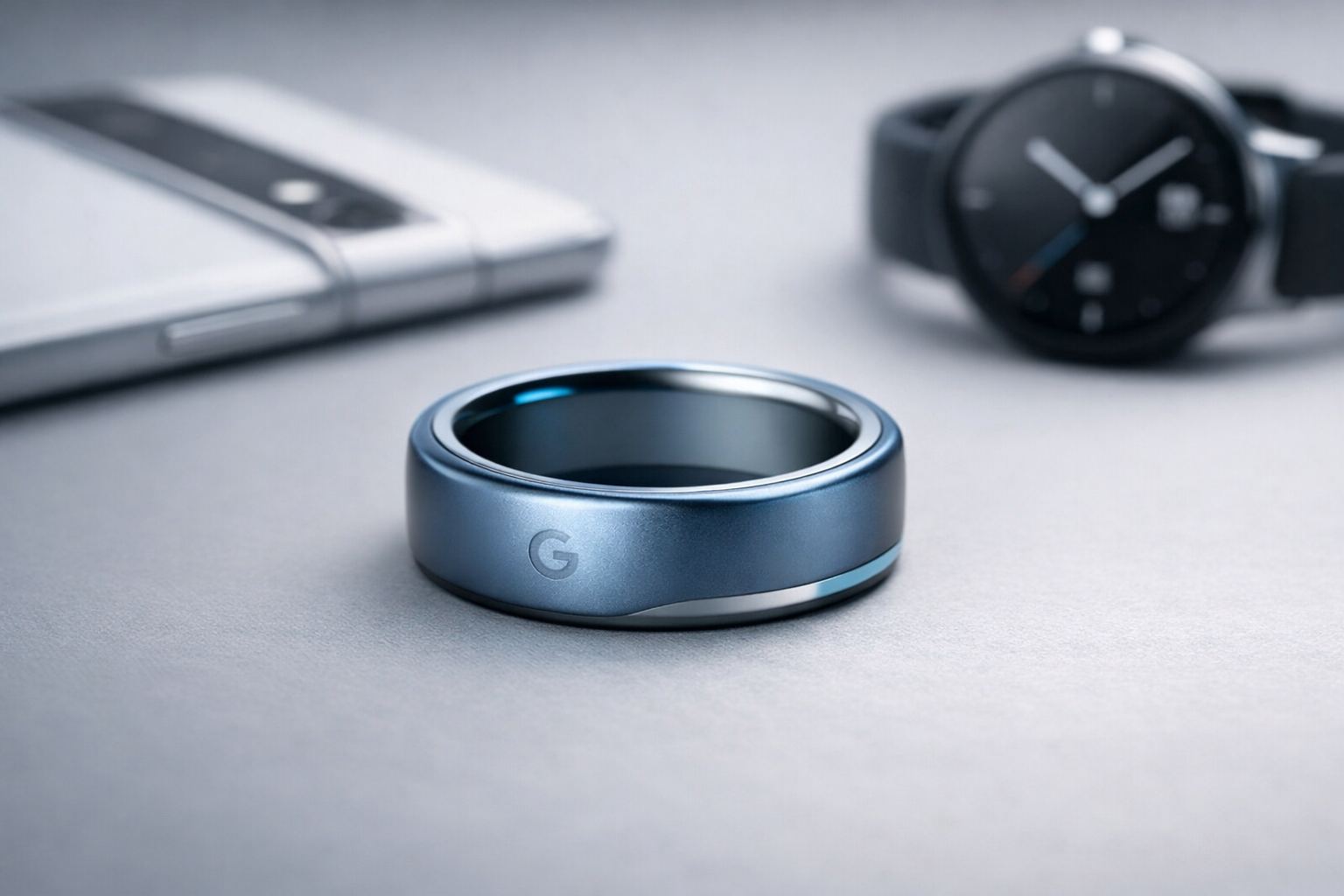
AI-generated Pixel Ring concepts already suggest a design language that feels modern and distinctly “Pixel.” Even without a display, thoughtful finishes and colorways could make it the most attractive smart ring on the market.
Battery life: a chance to change the Pixel narrative
Battery life remains the Achilles’ heel of many Pixel wearables. Ironically, a smart ring could be where Google finally flips that narrative.
With fewer components than a watch, a Pixel Ring could realistically achieve:
- 7+ days of battery life
- Intelligent sensor scheduling driven by AI
- Power-sharing logic when paired with a Pixel Watch
Samsung already claims up to 30% efficiency gains when ring and watch are worn together. Google could implement a similar — or more advanced — system using Android-level optimization.
Pricing and subscriptions: the biggest opportunity
This is where Google could win instantly.
Smart rings are expensive, but what frustrates users most is paying again just to access their own data. Google doesn’t need to eliminate subscriptions entirely, but it should:
- Provide core health metrics for free
- Keep advanced coaching optional
- Avoid locking historical data behind paywalls
Fitbit Premium already exists — the challenge is ensuring it enhances the experience rather than being mandatory.
Ecosystem power: where a Pixel Ring would truly shine
A Pixel Smart Ring wouldn’t exist in isolation. It could:
- Sync seamlessly with Pixel phones
- Share data with Pixel Watch for better accuracy
- Feed into Google Health and Fitbit dashboards
- Enable subtle gesture controls for Pixel devices
- Act as a backup health tracker when the watch is charging
No existing smart ring offers this level of platform synergy.
Why 2026 makes sense
There are no confirmed leaks or announcements — but that’s not unusual for Google. Wearable development cycles are long, and smart rings are finally mature enough to justify a Pixel-branded entry.
By 2026:
- Consumers will be more educated about smart rings
- First-gen issues from competitors will be well understood
- AI-driven health insights will be expected, not optional
Google could enter at exactly the right moment.
Google Pixel Ring (Expected) vs Oura Ring 4 vs Samsung Galaxy Ring
| Feature | Google Pixel Ring (Expected 2026) | Oura Ring 4 (Ceramic Edition) | Samsung Galaxy Ring (Gen 1) |
|---|---|---|---|
| Launch Status | Expected / Rumored | Available | Available |
| Target Ecosystem | Pixel + Android + Fitbit | Cross-platform (iOS & Android) | Samsung Galaxy ecosystem |
| Primary Focus | AI-driven health insights + ecosystem synergy | Sleep & recovery tracking | Health tracking + Galaxy Watch pairing |
| Sensors | HR, HRV, SpO₂, skin temperature, accelerometer (expected) | HR, HRV, SpO₂, skin temperature, accelerometer | HR, HRV, SpO₂, skin temperature, accelerometer |
| Battery Life | 7+ days (expected) | 5–8 days | 5–7 days |
| Charging | Wireless charging case (expected) | Wireless charging dock | Wireless charging dock |
| Subscription | Optional (best-case scenario) | Required for full features | No subscription |
| Health Platform | Google Health + Fitbit | Oura App | Samsung Health |
| Durability | Ceramic or hardened alloy (expected) | Ceramic / titanium finishes | Titanium |
| Scratch Resistance | High (expected improvement) | Good | Mixed user reports |
| Display | None (possible experimental micro-display) | None | None |
| Price Range | $299–$349 (expected) | $449+ | $399 |
| Key Advantage | AI + ecosystem intelligence | Best sleep tracking | Galaxy Watch synergy |
| Key Weakness | Unknown availability | Subscription dependency | First-gen reliability concerns |
❤️ Health Tracking Capability Comparison
| Health Metric | Pixel Ring (Expected) | Oura Ring 4 | Galaxy Ring |
|---|---|---|---|
| Sleep Stages | ✔ Advanced (Fitbit-based) | ✔ Excellent | ✔ Good |
| Heart Rate (24/7) | ✔ | ✔ | ✔ |
| Heart Rate Variability (HRV) | ✔ | ✔ | ✔ |
| Blood Oxygen (SpO₂) | ✔ | ✔ | ✔ |
| Skin Temperature Trends | ✔ | ✔ | ✔ |
| Recovery / Readiness Score | ✔ AI-enhanced | ✔ | ✔ |
| Stress Detection | ✔ Expected | ✔ | Limited |
| Menstrual Cycle Tracking | ✔ Fitbit-powered | ✔ | ✔ |
| AI Coaching | Strong potential | Moderate | Basic |
| Historical Data Access | ✔ Free (expected) | ❌ Subscription | ✔ Free |
🔋 Battery & Power Strategy Comparison
| Aspect | Pixel Ring (Expected) | Oura Ring 4 | Galaxy Ring |
|---|---|---|---|
| Average Battery Life | 7+ days | 5–8 days | 5–7 days |
| Battery Optimization | AI-based sensor scheduling | Static optimization | Watch-ring load sharing |
| Watch Integration | Pixel Watch power sharing | None | Galaxy Watch synergy |
| Charging Time | ~60–90 minutes (expected) | ~80 minutes | ~90 minutes |
| Battery Health Concerns | Unknown | Stable | Some reported swelling |
🌐 Ecosystem Integration Comparison
| Integration Area | Pixel Ring | Oura Ring | Galaxy Ring |
|---|---|---|---|
| Smartphone Sync | Android (deep) | Android & iOS | Galaxy phones |
| Smartwatch Pairing | Pixel Watch | None | Galaxy Watch |
| Cloud Intelligence | Google AI + Fitbit | Oura Cloud | Samsung Health |
| Smart Home | Google Home (potential) | None | SmartThings |
| Cross-Device Context | Strong | Weak | Moderate |
Final Thoughts
A Google Pixel smart ring arriving in 2026 wouldn’t just be another wearable launch — it could mark a turning point for the entire smart ring category.
Right now, smart rings sit in an awkward middle ground. They promise powerful health insights with minimal effort, yet they’re held back by compromises: short battery life for the price, durability concerns, shallow ecosystem integration, and in some cases, mandatory subscriptions that lock away users’ own data. Oura leads on health accuracy, Samsung leans on ecosystem pairing, but neither fully solves the equation.
Google is one of the few companies capable of doing so.
With Fitbit’s proven health science, Pixel’s refined hardware design, and Google’s unmatched AI capabilities, a Pixel Ring could deliver smarter insights rather than just more data. It could also set a new expectation around ownership — where essential health metrics are accessible without monthly fees, and premium features feel optional rather than forced.
Just as importantly, Google could make the smart ring feel like a natural extension of a wider ecosystem. A Pixel Ring working in harmony with a Pixel Watch and Pixel phone could improve accuracy, extend battery life, and provide a more complete picture of a user’s health than any single device can today. That kind of cross-device intelligence is something no current smart ring truly offers.
There are no guarantees, and no confirmed leaks — but the timing feels right. By 2026, consumer awareness of smart rings will be higher, expectations will be clearer, and first-generation mistakes from competitors will be well understood. If Google chooses that moment to enter the market with a polished, thoughtfully priced, and genuinely intelligent Pixel Ring, it wouldn’t just compete with Oura and Samsung — it could redefine what people expect from a smart ring altogether.
Wonderful beat I wish to apprentice while you amend your web site how could i subscribe for a blog web site The account aided me a acceptable deal I had been a little bit acquainted of this your broadcast provided bright clear idea
Thanks a lot.
Magnificent beat I would like to apprentice while you amend your site how can i subscribe for a blog web site The account helped me a acceptable deal I had been a little bit acquainted of this your broadcast offered bright clear idea