From the moment Samsung stepped onto the CES 2026 stage, it was clear that the company intended not just to participate in the annual electronics spectacle, but to set the terms of the conversation about the next era of television technology. Indeed, while OLED and Mini LED remain important parts of the broader display landscape, this year’s narrative was dominated by a newly defined middle ground — one that Samsung is actively shaping around Micro RGB backlighting, smarter AI‑driven picture and sound processing, and a broader ecosystem of user experiences. Rather than presenting a single flagship or incremental spec bump, Samsung’s 2026 slate represents a coordinated strategy designed to address real viewing scenarios from bright living rooms to cinematic darkness, and from passive watching to active interaction.
To frame how Samsung’s approach stands out, and how it compares with contemporaneous efforts from LG and TCL, one must first understand the context in which these announcements were made. At CES, next‑generation TVs were everywhere — from ultra‑bright Mini LED models and new OLED designs to the first significant commercial push behind RGB LED backlight technologies that promise to challenge the balance of power between LCD‑based displays and self‑emissive panels. (Yahoo Tech) In this technological contest, Samsung’s playbook was ambitious, comprehensive, and deeply rooted in both engineering evolution and AI‑assisted innovation.
A New Chapter Begins: Micro RGB Defined
When Samsung unveiled its Micro RGB televisions at CES, it did so with a deliberate narrative. Rather than talking about incremental improvements, the company positioned Micro RGB as a fundamental evolution of LED backlighting technology — one that replaces conventional white LEDs with microscopic red, green, and blue LEDs in the backlight plane. The effect is profound: by generating true RGB light at the source, Samsung’s Micro RGB architecture enables wider color gamut coverage and drastically finer control over local luminance, solving a long‑standing limitation of traditional LCD and Mini LED displays. (Samsung Global Newsroom)
This design choice means that color is generated more accurately rather than filtered after the fact, enabling Samsung to claim 100 % coverage of the BT.2020 color space and achieve VDE certification for color precision — a significant benchmark in wide‑gamut performance. (Samsung Global Newsroom) But even beyond raw specifications, what truly distinguishes Micro RGB is how it works alongside Samsung’s Micro RGB AI Engine Pro, a computational suite that dynamically analyzes each frame to adjust color, contrast, and brightness on the fly. This shift toward computational competence — where the hardware and software collaborate in real time — reflects a broader industry transition in which AI is not just a feature but a fundamental layer of visual performance.
In practical terms, this means that scenes with muted tones become more vivid and detailed, and high‑dynamic‑range content is rendered with both deeper shadows and brighter highlights than most current LCD‑based technologies can muster. Moreover, Samsung’s ongoing commitment to reducing screen glare through proprietary Glare Free coatings helps ensure this performance is not merely theoretical but usable in real living environments — especially bright rooms where traditional OLED often struggles. (Samsung Global Newsroom)
The 130‑Inch Statement Piece and the Broader Lineup
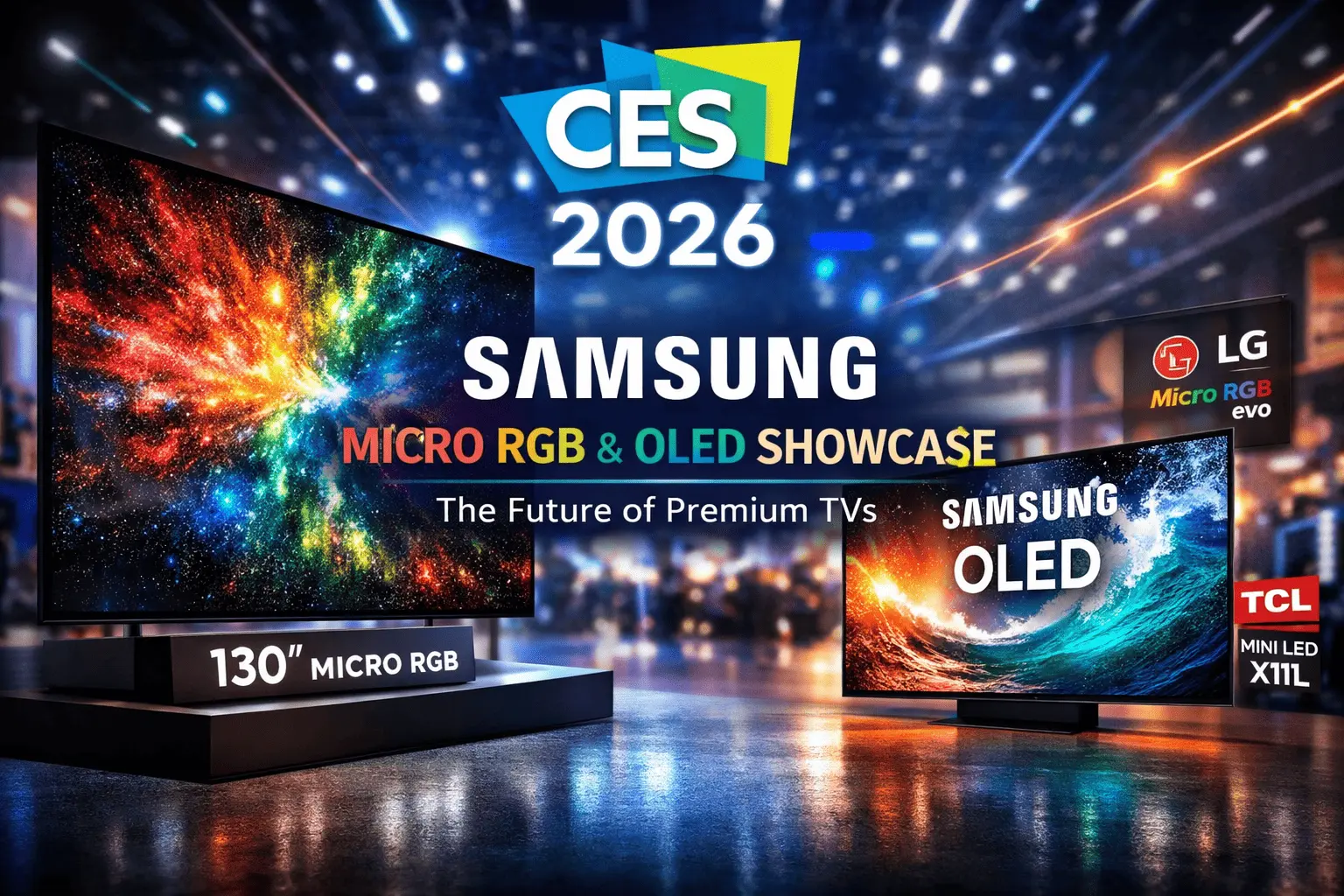
Although the 130‑inch Micro RGB concept rapidly became one of the defining visual moments of CES, it is important not to view this gargantuan display as an isolated art piece; rather, it is a symbol of Samsung’s engineering direction. Designed with a “Timeless Frame” aesthetic that blurs the line between hardware and architectural installation, the 130‑inch model embodies both technical performance and lifestyle ambition. It demonstrates that the performance benefits of Micro RGB — notably precise color and wide gamut coverage — can be scaled up without the picture degradation that typically afflicts oversize LCD televisions. (Samsung Global Newsroom)
However, Samsung’s strategy goes well beyond a single flagship. For 2026, the company is bringing Micro RGB to a broad range of screen sizes, spanning from more accessible 55‑inch and 65‑inch formats all the way up to 115‑inch models. This deliberate expansion signals an intention to make next‑generation display technology not just aspirational but practically available to mainstream buyers. (Business Standard) It also reflects an understanding that real living environments vary widely, and that premium picture quality must be adaptable to both compact urban homes and expansive home theaters.
A Tale of Two Technologies: Micro RGB vs OLED
Nonetheless, Samsung’s emphasis on Micro RGB does not diminish its continued investment in OLED technology. In fact, the company’s 2026 QD‑OLED lineup — including models like the S95H, S90H, and S85H — represents a parallel track of innovation that targets contrast and cinematic depth in ways that Micro RGB, by its nature, cannot fully replicate.
OLED’s self‑emissive pixels allow for true black levels and virtually infinite contrast ratios, making dark scenes look more organic and shadow detail more nuanced than nearly any backlit display can achieve. Even so, OLED has historically struggled with peak brightness in bright environments, which is where technologies like Micro RGB — and bright Mini LEDs — offer a compelling alternative. Moreover, Samsung’s OLED updates incorporate AI enhancements such as Vision AI‑driven motion smoothing and adaptive sound optimization, which bring a level of contextual intelligence to content playback that differentiates them from competitors who rely primarily on panel hardware for improvements.
For consumers, this dual strategy means that Samsung is not asking buyers to choose between quantity and quality; rather, it is offering options tailored to different needs. Those who prioritize bright‑room viewing, HDR highlights, and expansive color gamuts may find Micro RGB more compelling, while cinephiles and viewers seeking absolute contrast fidelity may gravitate toward the latest OLED models.
Competitive Dynamics: Samsung, LG, and TCL
In contrast to Samsung’s multifaceted approach, its competitors have taken slightly different paths at CES 2026. LG, for example, introduced its Micro RGB evo displays, which similarly replace white LED backlights with independent RGB LEDs to unlock a wide gamut and refined local dimming. LG has taken particular pride in certifying its displays for multiple professional color spaces — including BT.2020, DCI‑P3, and Adobe RGB — and in applying its deep experience in OLED processing to its RGB LCD implementations. These televisions also deploy a sophisticated AI processor to improve upscaling and color fidelity, demonstrating how LG intends to leverage both hardware and software improvements to push picture quality forward. (LG AU)
It is important to note, however, that while LG’s Micro RGB evo claims “OLED‑like precision,” the underlying architecture remains a backlit LCD system, and many observers have pointed out that real self‑emissive contrast remains out of reach for purely backlit approaches. Nonetheless, by bringing together a decade of OLED picture tuning expertise with a new RGB backlight scheme, LG signals that it intends to compete aggressively across both LED and self‑emissive display categories.
Meanwhile, TCL’s CES presence highlighted a continued focus on extreme brightness and local dimming refinement. Models like the X11L SQD‑Mini LED TV showcase peak luminance figures that rival or exceed many current OLED panels, alongside extremely dense local dimming arrays designed to minimize blooming and maximize contrast for HDR content. This emphasis on sheer brightness — combined with fast refresh rates that make the models attractive for gaming and sports — illustrates a different dimension of premium performance. Yet, because TCL’s approach still relies on white or quantum‑dot enhanced LEDs rather than RGB backlights, color purity and gamut breadth typically lag behind what Samsung and LG are promising with their next‑generation RGB architectures.
Taken together, these varied strategies indicate that the premium display market in 2026 is not converging on a single “best” technology, but rather expanding into a spectrum of specialized, high‑performance experiences — each with its own strengths, tradeoffs, and ideal use cases. (TechRadar)
AI and the Future of Intelligent Viewing
Perhaps most striking about Samsung’s 2026 TV strategy is how deeply AI is woven into both the visual and user experience layers. The Micro RGB AI Engine Pro does more than adjust color; it is part of a broader Vision AI ecosystem that includes contextual content recommendations, voice interaction, and adaptive audio systems that respond to different program types. In this way, Samsung is positioning its displays not merely as passive screens but as intelligent entertainment hubs that anticipate and respond to the needs of users.
This emphasis on intelligence continues a broader industry trend where processors, machine learning models, and contextual metadata increasingly influence perceived picture quality. Whereas earlier generations of TVs competed primarily on spec sheets, today’s premium models are distinguished by their ability to interpret content, optimize across viewing conditions, and surface experiences that feel personalized and living‑room friendly.
Market Implications and the Broader Impact
What emerges from CES 2026 is a television landscape that is both more complex and more exciting than ever before. Samsung’s Micro RGB initiative suggests that the long‑awaited convergence between LCD brightness and OLED color fidelity may finally be within reach, even if each underlying technology still has inherent limits. LG’s concurrent investments in RGB backlight refinement and OLED expertise indicate that standing still is not an option — and that each company is experimenting with how best to unify hardware and intelligence. Meanwhile, TCL’s brightness‑first strategy underscores that there is still meaningful room for innovation within existing LCD subclasses.
For consumers, the implications are clear: 2026 will be a year where choice and context matter more than single metrics like contrast or peak nits. Instead, viewers will have to consider factors such as ambient lighting conditions, content type, room size, and personal priorities to decide which technology best meets their needs. As a result, the premium TV market is likely to become more nuanced, with each major player carving out differentiated value propositions rather than racing toward a single monolithic ideal.
Conclusion: A New Era of Premium Displays
In the end, Samsung’s CES 2026 television strategy is best understood not as a single technological breakthrough but as a comprehensive vision for the future of viewing. By pairing Micro RGB’s vast color capabilities and brightness finesse with refined OLED contrast and deep AI integration, Samsung is staking a claim to versatile, intelligent, and future‑ready displays that can adapt to a wide range of environments and content experiences.
While competitors like LG and TCL push their own innovations forward, Samsung’s blend of hardware depth and adaptive intelligence positions it to set the standard for what premium TVs are expected to deliver in 2026 and beyond. In this evolving landscape, the most compelling displays will not be defined solely by pixels or LEDs, but by their ability to think, adapt, and enhance the way we watch.