Apple does not always announce its biggest decisions with fireworks.
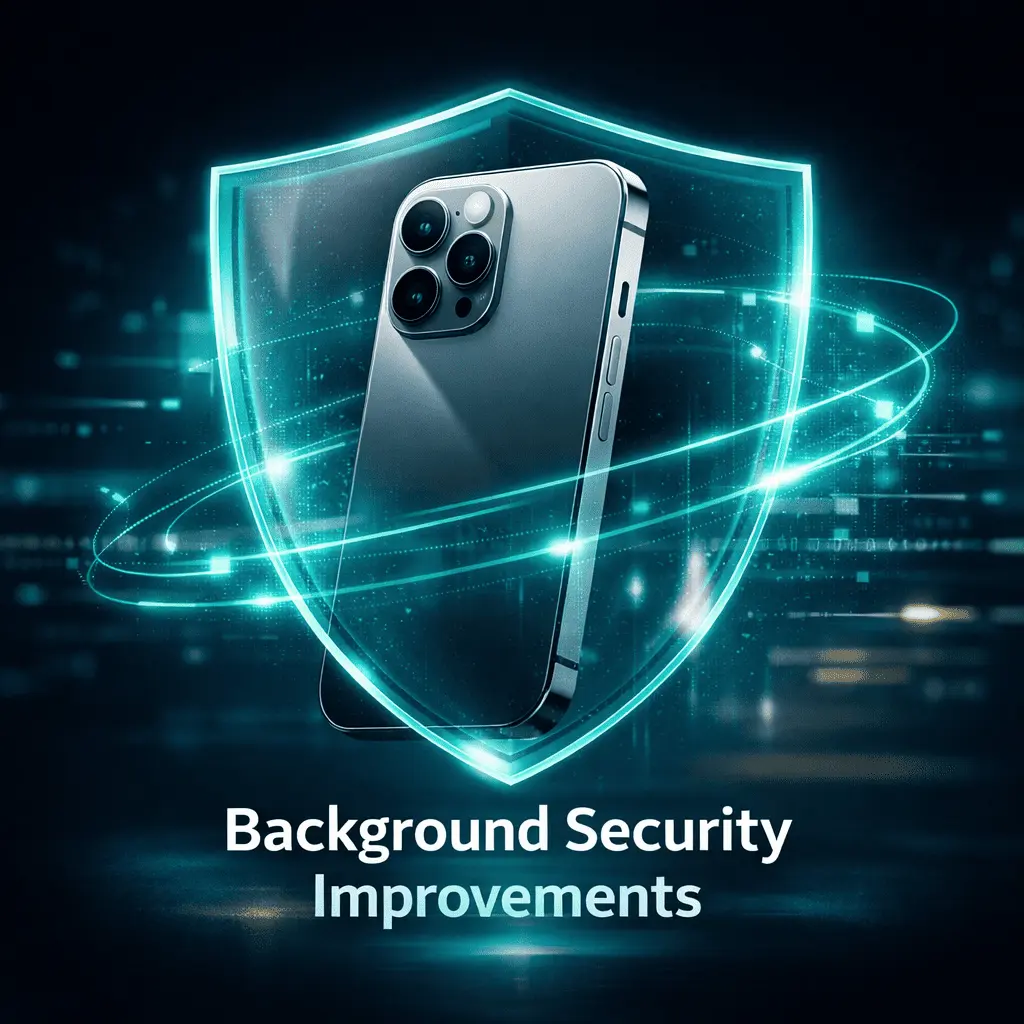
Sometimes, the most consequential changes arrive silently, embedded deep within beta releases, hidden in obscure settings menus, and understood only by a small group of developers and analysts. That appears to be exactly what is happening now with Apple’s new Background Security Improvements system—an initiative that could fundamentally redefine how iPhones are protected in an era of escalating digital threats.
The recent appearance of iOS 26.3 (a) and iOS 26.3 (b) is not just another beta anomaly. It is the first real-world test of a security architecture that separates protection from features, urgency from aesthetics, and safety from spectacle.
If Apple follows through, this shift may ultimately prove more important than any single iOS feature released this decade.
Why iPhone Security Has Reached a Breaking Point
To understand why Apple is doing this now, we must first understand the pressure Apple is under.
The modern iPhone exists in a threat landscape radically different from the one that shaped early iOS design. Cyberattacks are no longer isolated incidents or the work of lone hackers. They are industrialized, automated, and often state-sponsored. Zero-day exploits are discovered, weaponized, and deployed at unprecedented speed.
In this environment, time is the enemy.
A vulnerability that remains unpatched for even a few days can expose millions of devices. Yet Apple’s traditional update model—while stable and polished—was never designed for rapid, surgical response.
This tension has been growing quietly for years.
The Old Model: Secure, But Slow
Historically, Apple’s iOS update strategy prioritized stability and user experience above all else.
How it worked:
- Security fixes were bundled into full iOS releases or point updates
- Updates required user awareness and interaction
- Even emergency patches went through rigid release processes
- Updates were permanent once installed
This model worked well when:
- Threats evolved slowly
- Exploits were rare
- Smartphones were less central to daily life
But that world no longer exists.
Apple vs Apple: Why the Old System Was No Longer Enough
Apple recognized this limitation and tried to address it incrementally.
Rapid Security Response (iOS 16)
This was Apple’s first attempt to speed things up.
Strengths:
- Faster than full updates
- More focused on security
Weaknesses:
- Limited scope
- Still tied to OS structure
- No easy rollback
- Confusing for users
- Rarely deployed
Rapid Security Response was not a failure—but it was not a solution either. It treated the symptom, not the disease.
Background Security Improvements: A Structural Reset
Background Security Improvements represent a philosophical reset, not an incremental tweak.
Instead of asking:
“How can we deliver security faster?”
Apple is now asking:
“Why is security tied to feature updates at all?”
This distinction matters.
Traditional iOS Updates vs Background Security Improvements
| Aspect | Traditional iOS Update | Background Security Improvements |
|---|---|---|
| Scope | Features + security | Security only |
| Speed | Weeks or months | Potentially immediate |
| User action | Required | Optional / automatic |
| Visibility | High | Low |
| Risk tolerance | Conservative | Adaptive |
| Rollback | Not practical | Built-in |
| Dependency | OS release cycle | Independent |
This is not an optimization—it is a separation of concerns.
Why the Location in Settings Is So Important
Apple didn’t just change how updates work. It changed where they live.
Background Security Improvements appear under:
Settings → Privacy & Security
Not under Software Update.
This placement is deeply symbolic.
It reframes security as:
- A privacy issue
- A continuous responsibility
- A background service, not a user task
This mirrors how Apple already treats things like encryption, permissions, and device integrity.
Security is no longer episodic. It is ambient.
Apple vs Android Security Models
Android supporters often point to monthly security patches as evidence of flexibility. And in theory, Android does deliver security updates separately from major OS versions.
But theory and reality diverge sharply.
Android Reality:
- Updates depend on manufacturers
- Carrier approval causes delays
- Many devices never receive patches
- Fragmentation weakens consistency
Apple Reality:
- Centralized control
- Immediate global deployment
- Uniform user experience
- Long device support lifespan
With Background Security Improvements, Apple combines Android’s speed with Apple’s control.
This could result in the fastest, most reliable consumer security update system in the industry.
The Rollback Feature: Apple’s Quiet Revolution
Perhaps the most radical change is also the least discussed.
For the first time, Apple allows users to remove a security update.
This may sound minor, but it breaks decades of Apple tradition.
Historically:
- Updates were final
- Reversibility was discouraged
- Stability was enforced top-down
Now, Apple is acknowledging a reality long accepted in enterprise IT: no update is perfect.
By allowing rollback:
- Apple reduces fear of immediate installation
- Enterprises gain confidence
- Power users regain agency
- Apple can move faster with less risk
This is not a loss of control. It is a redistribution of responsibility.
Consumer vs Enterprise Security Expectations
Enterprise environments have long demanded:
- Granular update control
- Rollback options
- Rapid patching
- Minimal disruption
Consumer devices traditionally did not.
Apple is now bringing enterprise-grade security philosophy to consumer iPhones—without exposing users to complexity.
This is rare.
Most companies move in the opposite direction.
Why Apple Is Testing Without Shipping Real Fixes
The decision to deploy iOS 26.3 (a) and (b) without actual security fixes is intentional and revealing.
Apple is testing:
- Delivery pipelines
- Installation behavior
- Telemetry accuracy
- User interface clarity
- Rollback reliability
- Cross-device compatibility
This is infrastructure testing, not content testing.
In software terms, Apple is validating the highway before sending traffic.
Feature Innovation vs Infrastructure Innovation
Features generate headlines:
- AI tools
- Camera upgrades
- Interface redesigns
Infrastructure determines survival.
Many tech companies fail not because their features are weak, but because their infrastructure cannot adapt to new realities.
Apple appears to understand this deeply.
By investing in security infrastructure now, Apple is buying itself:
- Faster response times
- Lower long-term risk
- Greater ecosystem resilience
This is not exciting innovation. It is essential innovation.
Why the Missing iOS 26.3 Beta Matters
The absence of the expected iOS 26.3 beta is telling.
Apple has effectively paused feature progression to stabilize its security foundation.
That decision suggests:
- Background Security Improvements are blocking progress
- Apple considers them foundational
- Future iOS development depends on this system
In other words, this is not optional.
Apple Today vs Apple Five Years Ago
Five years ago:
- Security updates were reactive
- Zero-days caused panic releases
- Users were urged to update urgently
- Rollbacks were nearly impossible
Today:
- Security is proactive
- Delivery is modular
- Risk is managed dynamically
- User trust is preserved
This is institutional maturity.
Risks Apple Is Accepting
No transformation comes without danger.
Potential risks include:
- Silent failures at scale
- Reduced user awareness
- Over-automation
- Increased complexity behind the scenes
Apple mitigates these risks with:
- Beta testing
- Rollback capability
- Gradual rollout
- Clear internal boundaries
The company is not moving recklessly. It is moving deliberately.
Why This Change Matters More Than Any iOS Feature
Features age.
Security infrastructure compounds.
A camera feature matters for a year.
A UI redesign matters for two.
A security architecture matters for a decade.
Background Security Improvements will shape:
- How Apple responds to future threats
- How users perceive updates
- How competitors must respond
- How long devices remain safe
This is not a version update.
It is a generational shift.
The Quiet Start of a New Security Era
Apple did not announce this change because it does not need applause.
It needs reliability.
By testing quietly, iterating rapidly, and prioritizing safety over spectacle, Apple is doing what it does best when it matters most.
Most users will never know why their iPhone stayed secure.
And that may be the ultimate measure of success.
Final Thoughts:
The most important technology advances are often invisible.
They do not dazzle.
They do not trend.
They simply work—again and again—when failure is not an option.
Apple’s Background Security Improvements may never appear in a keynote.
But years from now, they may be remembered as the moment Apple quietly solved one of the hardest problems in modern consumer technology.
Security, finally, is no longer waiting for the next update.