

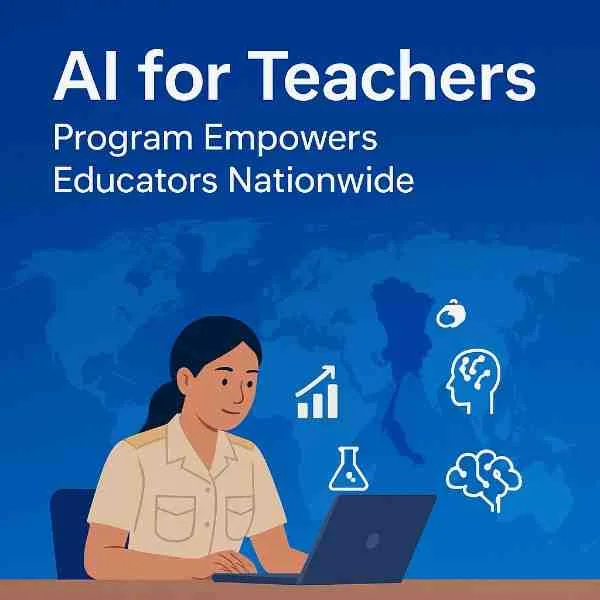
Across the sprawling landscapes of Thailand — from Bangkok’s bustling classrooms to the quiet rural schools nestled among rice paddies — a quiet revolution is taking place. It’s not the arrival of new textbooks or blackboards, but something far more transformative: artificial intelligence in the hands of teachers.
In late 2025, a landmark collaboration between Microsoft Thailand and the Ministry of Education set out to rewrite the story of how Thai teachers teach and students learn. The initiative, called “AI for Teachers,” is part of a broader movement to prepare educators for a future where technology and humanity must evolve hand in hand.
The program — launched in partnership with OBEC (Office of the Basic Education Commission), OVEC (Office of the Vocational Education Commission), IPST (Institute for the Promotion of Teaching Science and Technology), and ETDA (Electronic Transactions Development Agency) — aims to equip more than 150,000 teachers with the knowledge, tools, and confidence to integrate artificial intelligence into everyday learning.
A National Mission to Empower Educators
For decades, Thai teachers have faced the uphill task of balancing limited resources, overcrowded classrooms, and the growing expectations of a digital generation. The AI for Teachers program, according to the Ministry of Education, represents a turning point — not just in skill development but in redefining what it means to teach in the 21st century.
“It’s about more than learning to use AI tools,” says a senior advisor at OBEC. “It’s about helping teachers think critically, work creatively, and inspire students to do the same. When we strengthen teachers, we strengthen the nation.”
From the start, the initiative’s design was deeply inclusive. Whether a primary school teacher in Chiang Rai or a vocational instructor in Phuket, every participant can access the program’s digital training platform. The courses — free of charge and self-paced — are structured around three comprehensive modules, covering AI literacy, responsible use, classroom application, and professional development.
Learning to Teach with Tomorrow’s Tools
At the heart of the curriculum lies a simple principle: teachers must first understand AI before they can teach its value to others.
The first module, AI Fundamentals and Governance, builds the foundation. It demystifies AI by explaining how algorithms work, why ethical frameworks matter, and how bias in data can affect students’ understanding of technology. Teachers learn to see AI not as a threat but as a partner — a digital assistant capable of amplifying creativity and personalizing learning.
Next comes Developing Performance Agreements with AI, a module tailored to the realities of modern teaching. Thai educators often face the burden of paperwork, self-assessment, and professional evaluation. Here, they learn how AI can streamline those processes — from drafting performance agreements (PAs) to generating research insights and reflective teaching plans.
The third module, AI for Teaching and Assessment, shifts focus to the classroom. Teachers are trained to design lessons that integrate AI-driven tools — such as adaptive quizzes, language translation software, and data-informed grading systems. The goal is not automation but augmentation: giving teachers the time and insight to focus on human connection, empathy, and mentorship.
A Wave of Enthusiasm
When the program’s first phase launched on October 15, 2025, the response was overwhelming. Within days, more than 36,000 teachers had registered — representing nearly every province and subject area in the country.
For many, this was their first structured experience learning about AI. “I used to think AI was only for engineers,” says Supattra, a secondary school English teacher from Khon Kaen. “Now I use it to help students write essays, check grammar, and explore global ideas. It has changed how I teach — and how they learn.”
Teachers who missed the live sessions were not left behind. The program offers video-based, self-paced learning until November 20, allowing even those in remote regions to participate and earn completion certificates.
By January 2026, the program will expand to include 100,000 vocational educators, a move that could reshape Thailand’s technical and trade schools — the backbone of its skilled workforce.
Collaboration That Inspires Change
Microsoft’s involvement is more than corporate philanthropy. It aligns with the company’s global “Elevate Thailand” strategy, which aims to democratize access to digital skills and empower educators as catalysts for transformation.
“This is not just training — it’s capacity building,” says a Microsoft Thailand spokesperson. “When you equip one teacher with AI literacy, you empower hundreds of students to think differently about the world. The ripple effect is enormous.”
In partnership with government agencies, Microsoft also plans to organize innovation competitions where teachers can showcase their AI-integrated classroom projects. Winning entries will be highlighted on national platforms, offering educators recognition and inspiring others to innovate.
The Broader Picture: Building a Future-Ready Nation
Thailand’s education system, like many around the world, faces a crucial inflection point. The digital divide — between urban and rural, young and old, resource-rich and resource-poor — threatens to widen unless proactive measures are taken.
The AI for Teachers initiative is a direct response to that challenge. By ensuring that teachers from every background have equal access to AI knowledge, the program promotes both technological equity and educational resilience.
Education experts say this shift is vital for Thailand’s long-term competitiveness. “We’re not just training teachers to use AI,” says Dr. Nattapong, an education policy researcher at IPST. “We’re helping them prepare a generation that can live, work, and lead in a world where AI literacy is as fundamental as reading and writing.”
Beyond the Classroom
Participants who complete all three modules receive not only digital certificates but also a project diploma, validating their mastery of AI applications in education. Top-performing teachers can attend a two-day “Clip Media” workshop, where they’ll create original AI-powered educational materials — lesson videos, gamified quizzes, or interactive content — to compete in a national showcase.
The program’s official website already hosts hundreds of success stories and testimonials. Many teachers describe newfound confidence and creativity. Others speak of how AI has made their workloads lighter and their classrooms more dynamic.
“It’s not about replacing teachers,” says another educator from Chiang Mai. “It’s about giving us back the time to do what we love — teaching.”
Reimagining Education, Together
As Thailand steps deeper into the digital age, the AI for Teachers program stands as a model of what collaborative innovation can achieve. By uniting government agencies, private sector leaders, and educators under one vision, it’s setting a precedent for how nations can blend technology with compassion, and progress with purpose.
In every sense, this initiative is more than a course — it’s a movement. A movement reminding the world that when teachers are empowered, students thrive. And when knowledge meets empathy, technology becomes not just a tool but a bridge — connecting generations to a smarter, fairer, and more hopeful future.


yay google is my king aided me to find this great web site! .