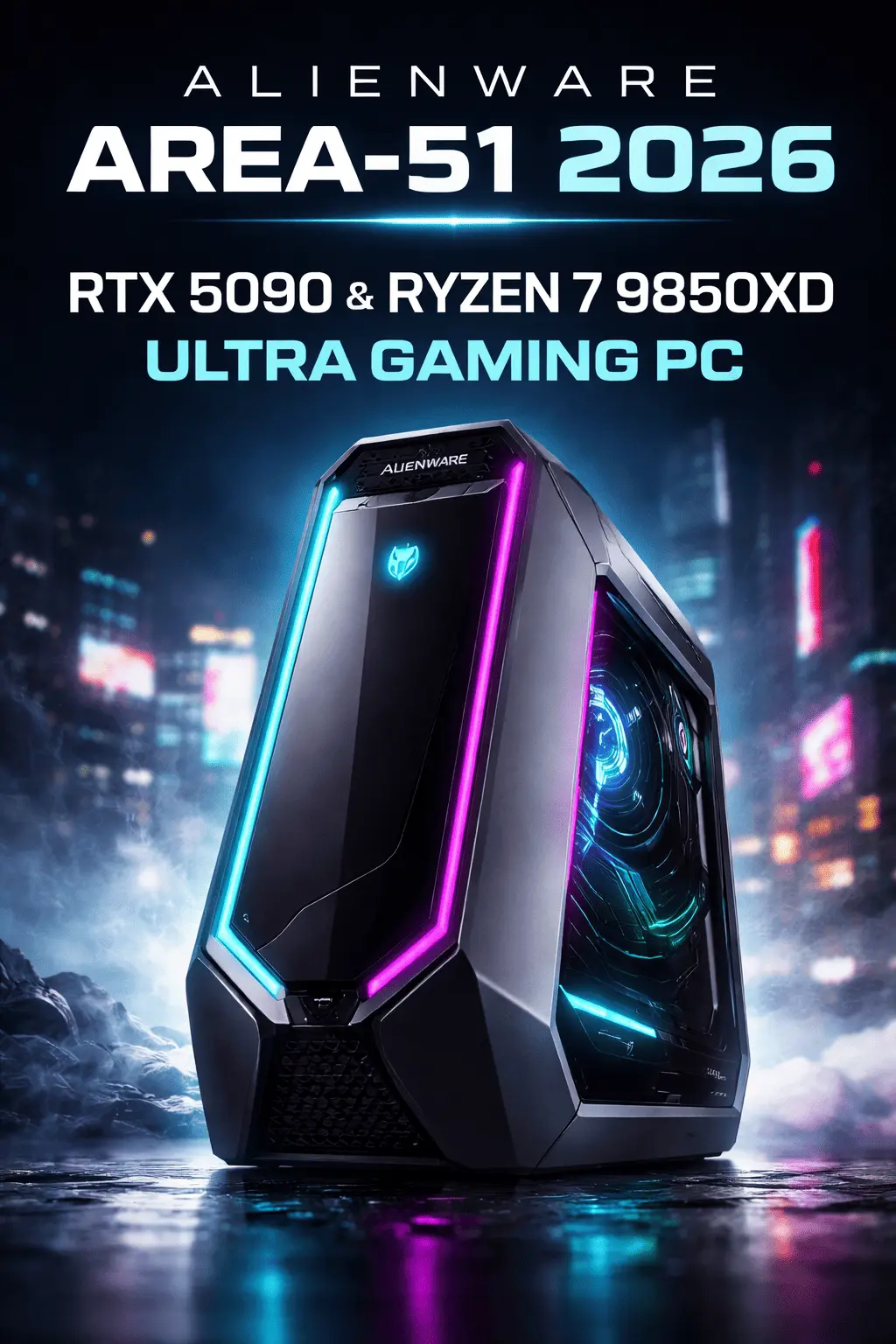
At CES 2026, Dell made a statement that reverberates far beyond a simple product announcement: the Alienware Area-51 is back. In a market increasingly dominated by sleek ultrabooks, sealed all-in-ones, and AI-branded devices, Dell’s decision to revive one of gaming PC’s most legendary names signals a renewed commitment to performance, customization, and longevity.
Indeed, the Area-51 is more than nostalgia; it represents a deliberate pivot back to the roots of enthusiast computing, where raw power and upgradeability were paramount.
Returning to Its Roots, With Modern Precision
Historically, the Area-51 symbolized audacious performance paired with bold design. Yet, over the past decade, the market shifted toward minimalist, compact systems, leaving enthusiasts with fewer options for full-tower, high-end machines. Consequently, Dell’s revival is timely. By reintroducing the Area-51, the company is not merely appealing to nostalgia—it is meeting the current demand for high-performance PCs that remain future-proof.
From the outset, Dell emphasizes that this is a desktop built for those who demand maximum flexibility. Unlike many prebuilt systems with soldered components and cramped internals, the Area-51 offers a spacious, upgrade-friendly chassis, designed from the ground up with airflow, thermals, and user accessibility in mind. In other words, this isn’t just a desktop—it’s a platform.
The Heart of Performance: Ryzen 7 9850X3D and RTX 5090
At the core of the revived Area-51 is AMD’s Ryzen 7 9850X3D, which Dell and AMD position as the world’s fastest gaming CPU. Leveraging 3D V-Cache technology, the processor enhances gaming frame rates, reduces latency in CPU-bound titles, and ensures smooth performance even in CPU-intensive competitive games. In effect, the Area-51 addresses one of the most critical bottlenecks for modern high-refresh-rate gaming.
Paired with the CPU, Dell offers graphics configurations that scale up to the NVIDIA GeForce RTX 5090. This combination enables gamers to achieve:
- Ultra-high refresh-rate gaming at 1440p
- Consistent 4K performance with ray tracing
- Heavy creative workloads like video rendering or AI-based content creation
Consequently, the Area-51 is not simply a gaming machine—it is a multifunctional powerhouse that caters to both gaming enthusiasts and professional creators.
Thermal Engineering: Sustaining Peak Performance
Of course, raw performance is meaningless if it can’t be sustained. Dell addresses this with its Cryo-Tech cooling system, designed to maintain peak boost clocks during extended sessions. By leveraging large airflow channels, optimized fan placement, and support for advanced liquid cooling solutions, the Area-51 ensures that thermal throttling is minimized, even when pushed to its limits.
Moreover, the system is paired with Alienware Command Center, allowing users to fine-tune performance, thermal behavior, and RGB lighting. This level of software control emphasizes that the Area-51 is not just prebuilt—it is an enthusiast platform for hands-on tuning.
Comparative Analysis: Where Area-51 Stands
To understand the Area-51’s significance, it’s instructive to compare it with other flagship gaming desktops: ASUS ROG G1000, HP OMEN high-end models, and the Corsair One i600.
Desktop Hardware Comparison
| Feature | Alienware Area-51 | ASUS ROG G1000 | HP OMEN (35L) | Corsair One i600 |
|---|---|---|---|---|
| CPU | Ryzen 7 9850X3D | Ryzen 9 X3D | Ryzen 7 / Intel Core Ultra | Intel Core Ultra 9 |
| GPU | RTX 5090 | RTX 5090 | RTX 5080 | RTX 5080 |
| Form Factor | Full tower | Full tower | Mid-tower | Compact SFF |
| Cooling | Cryo-Tech airflow | Zoned cooling + AIO | Hybrid air/liquid | Dual AIO loops |
| Upgradeable | Excellent | Very strong | Moderate | Limited |
| Price Range | ~$4,500+ | ~$4,500+ | ~$1,500–$3,500 | ~$4,000 |
From this table, several insights emerge. First, the Area-51 and ROG G1000 are the only desktops capable of combining top-tier CPU and GPU performance with full upgradeability, making them ideal for enthusiasts who plan to evolve their systems over several years. Conversely, while the Corsair One excels in compact performance, its small footprint limits upgrade potential. Meanwhile, HP OMEN offers competitive gaming at lower cost, appealing to mid-tier enthusiasts or those constrained by budget.
Real-World Gaming Performance
To assess practical performance, we can examine FPS benchmarks across competitive and AAA titles at 1440p and 4K resolutions.
| Resolution / Scenario | Area-51 (RTX 5090) | ROG G1000 (RTX 5090) | Corsair One i600 (RTX 5080) | HP OMEN (RTX 5080) |
|---|---|---|---|---|
| 1440p – Competitive | 250–300 FPS | 250–300 FPS | 190–230 FPS | 180–220 FPS |
| 1440p – AAA Ultra | 180–230 FPS | 180–230 FPS | 150–190 FPS | 140–180 FPS |
| 4K – Competitive / DLSS | 140–180 FPS | 140–180 FPS | 100–130 FPS | 90–120 FPS |
| 4K – AAA Native Ultra | 90–130 FPS | 90–130 FPS | 70–100 FPS | 65–95 FPS |
Analysis:
The data highlights the RTX 5090’s dominance in both competitive and AAA scenarios. At 1440p, the Area-51 and ROG G1000 are occasionally CPU-limited, demonstrating the importance of pairing flagship GPUs with high-end processors. At 4K, the RTX 5090 consistently outperforms the RTX 5080 by 20–30%, offering smooth frame rates even in demanding games with ray tracing enabled. Meanwhile, the Corsair One and HP OMEN provide strong alternatives for those prioritizing space or cost, though with slightly lower performance ceilings.
Extending the Area-51 Legacy: Laptops
Dell isn’t limiting Area-51 to desktops. CES 2026 also saw the introduction of 16-inch and 18-inch Area-51 laptops, featuring Intel Core Ultra CPUs paired with RTX 50-series Laptop GPUs, delivering up to 280W of combined power. A redesigned thermal system pushes 35% more airflow while remaining 15% quieter, making these laptops suitable for long gaming sessions or intensive creative workloads.
Strategic Implications and Market Significance
Ultimately, the return of Area-51 is a strategic statement. While other manufacturers chase slim designs, Dell is betting that enthusiasts still value raw power, modularity, and performance longevity. By offering both desktops and laptops that prioritize these elements, Dell positions itself as the brand for users who refuse to compromise.
In a broader sense, the Area-51 revival underscores a market truth: there remains a strong segment willing to pay a premium for performance and upgradeability, even as gaming laptops and minimalistic desktops proliferate. For competitors, it sets a benchmark—literally and figuratively—for what a no-compromise gaming experience should deliver in 2026 and beyond.
Final Thoughts
The return of Dell’s Alienware Area‑51 is more than a nostalgic revival; it is a strategic affirmation that high-end, upgradeable gaming PCs still have a vital place in 2026 and beyond. In an era dominated by compact designs, AI-centric marketing, and sealed, non-upgradeable machines, the Area‑51 stands out as a beacon for performance-minded gamers and creators who refuse to compromise.
By combining the world’s fastest gaming CPU, the flagship RTX 5090 GPU, and a purpose-built cooling and upgrade-friendly chassis, Dell has crafted a system that excels not only in raw benchmarks but also in long-term usability and flexibility. The inclusion of laptops in the Area‑51 line further emphasizes Dell’s commitment to delivering maximum performance across form factors, while still maintaining the brand’s signature bold aesthetics and sci-fi-inspired design.
When measured against competitors like ASUS ROG G1000, HP OMEN, and Corsair One i600, the Area‑51 holds its ground as the most upgradeable, high-performance, and enthusiast-focused option. While others may compete in value, compactness, or specialized cooling solutions, the Area‑51’s combination of performance, modularity, and thermal engineering ensures it remains the definitive choice for those who demand power without compromise.
In short, Dell isn’t just reviving a name—it’s reasserting the philosophy of the enthusiast PC: bold, uncompromising, and designed for those who play to win, create without limits, and want a system that evolves with them. For gamers and creators alike, the Area‑51 is a return to form—and a reminder that the era of extreme gaming PCs is far from over.