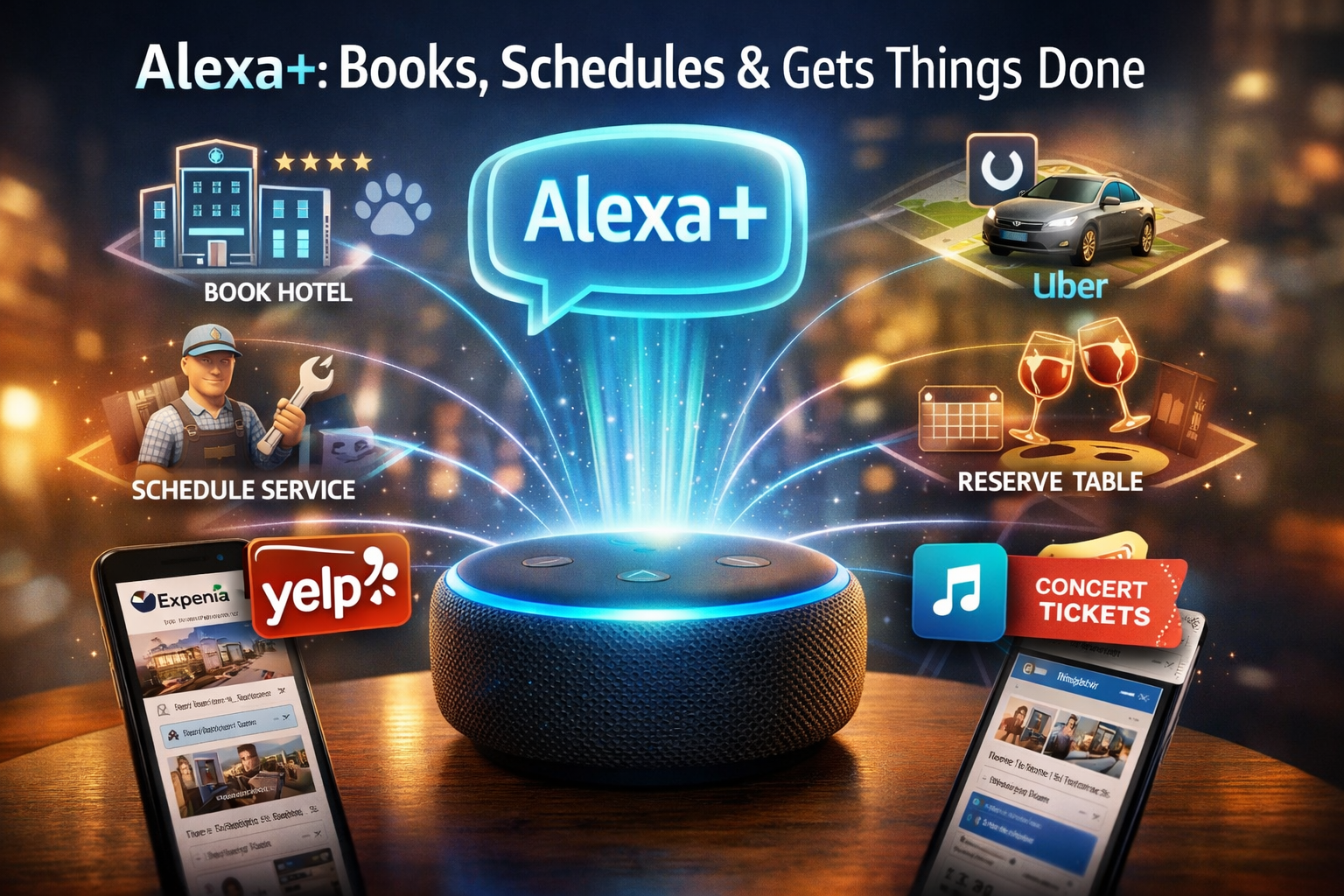
Amazon is significantly broadening the reach and functionality of its generative AI assistant Alexa+ by adding four major service integrations that will begin rolling out in 2026. This expansion goes beyond simple voice commands — it transforms Alexa+ into a proactive, task-capable digital assistant that can discover, book, and manage real-world services on behalf of users. (TechCrunch)
Alexa+ Continues Its Evolution
Alexa+, Amazon’s generative AI-powered version of its popular Alexa voice assistant, first debuted earlier this year as a more conversational and context-aware assistant. Unlike earlier Alexa versions — which relied mainly on fixed voice commands — Alexa+ uses large language models and “agentic AI” to interpret natural language and help users accomplish multi-step tasks. (euronews)
Already available via Echo devices, Fire TV, the Alexa mobile app, and even desktops, Alexa+ maintains context across conversations and devices and lets users refine requests through back-and-forth dialogue. (alexa.amazon.com)
The new service integrations now announced extend this agentic capability to travel planning, home services, wellness bookings, and local business discovery. (About Amazon)
✈️ Travel Made Conversational With Expedia
One of the most substantial additions is the Expedia integration, which lets Alexa+ effectively act as a travel agent. Through conversational requests, users will be able to:
- Search and compare hotels and lodging options using Expedia’s inventory.
- Provide preferences like location, price range, pet-friendliness, amenities, and more.
- Book and manage reservations directly through Alexa+ — without switching to a separate app or website.
For example, you could say things like “Show me boutique hotels in Paris under $250 per night next month,” and Alexa+ will walk you through options, refine the list based on your criteria, and complete the booking when you’re ready. (About Amazon)
This kind of conversational travel booking is designed to make planning simpler — especially for complex requests that normally require toggling between sites and filters. (About Amazon)
Home Services and Local Pros With Angi and Yelp
The integrations with Angi and Yelp are focused on home services and local business discovery.
Angi
- Lets users search for, compare, and request quotes from professional home service providers for tasks like plumbing, electrical work, landscaping, repairs, renovations, and more.
- Users can verbally describe the job and Alexa+ will surface nearby professionals, get estimates, and set appointments — all by conversation. (About Amazon)
Angi — formerly known as Angie’s List — has decades of experience connecting homeowners to vetted service pros, and adding this to Alexa+ injects that expertise into voice interactions for the first time. (About Amazon)
Yelp
- Provides access to business listings and reviews, broadening the range of local services Alexa+ can recommend.
- Alexa+ can use Yelp’s ratings and reviews to help users find and compare local pros for anything from home repairs to pet-care, and beyond. (About Amazon)
By combining Yelp’s expansive review database with voice-activated discovery, users can say things like “Find a top-rated plumber within 15 miles” and have Alexa+ present curated results with ratings, distance, and pricing context. (About Amazon)
💇♀️ Beauty & Wellness Booking With Square
Alexa+’s Square integration brings appointments and scheduling into natural conversation.
- Users will be able to find nearby beauty and wellness businesses — spas, hair and nail salons, barber shops, massage studios, and similar services — within Square’s network.
- Alexa+ can display availability, book appointments, and even reschedule them based on your spoken instructions. (About Amazon)
This kind of integration mirrors how many people currently use apps like OpenTable for restaurant reservations — but applied to a broader set of local services. (TechCrunch)
A Broader Vision: Alexa+ as an AI Service Hub
Taken together, these additions signal Amazon’s intent to position Alexa+ as more than a voice assistant. Instead, the company wants it to act as an AI-driven platform that connects users to essential daily services across domains like travel, home management, wellness, and local commerce — all through natural conversations. (theoutpost.ai)
Beyond these new integrations, Alexa+ already supports numerous third-party services such as Uber, OpenTable, Ticketmaster, Suno, Thumbtack, and Fodor’s travel guides — a growing ecosystem that spans booking, discovery, entertainment, and task automation. (Notes Read)
Amazon’s internal teams emphasize that Alexa+ is meant to simplify multi-step processes and reduce the friction of traditional online tasks. Instead of navigating menus and apps, users speak naturally and let the AI do the heavy lifting — whether that’s planning a trip, finding a contractor, or scheduling a spa visit. (theoutpost.ai)
📅 Real-World Rollout and Availability
While these integrations are slated to begin rolling out in 2026, Alexa+ itself has already been deployed in early access across Amazon’s ecosystem, including Echo speakers, Fire TV devices, and the Alexa app. (alexa.amazon.com)
The service keeps context across devices and lets users start a conversation on one device and continue on another — for example, beginning travel planning on a TV and finishing on a mobile phone. (alexa.amazon.com)
Current indications suggest Amazon will continue expanding Alexa+ capabilities and partnerships with third-party platforms — though exact timelines for global rollout and language support remain limited at this time. (alexa.amazon.com)
The Bigger Picture: AI Assistants as Tasks Executors
Amazon’s push underscores a broader tech industry trend: AI assistants are increasingly expected not just to provide information, but to act on behalf of users. Rather than simply retrieving answers, assistants like Alexa+ aim to complete transactions, make bookings, or manage services — effectively positioning themselves as agents rather than just interfaces. (theoutpost.ai)
This trend parallels integration efforts from other AI platforms — such as conversational models integrating apps like calendars, messaging, and commerce tools — and reflects changing expectations for how people interact with technology. (Notes Read)
However, adoption challenges remain. Users accustomed to mobile apps and visual interfaces may take time to adjust to conversational workflows. Success will depend on the AI’s ability to interpret complex intents accurately, avoid intrusive prompts, and provide reliable outcomes that match or exceed traditional methods. (theoutpost.ai)
Pros and Cons of Amazon Alexa+
Amazon’s Alexa+ represents a major shift from traditional voice assistants toward agent-based AI that can complete real tasks such as bookings, scheduling, and service discovery. While the approach offers clear advantages, it also introduces new challenges.
✅ Pros of Alexa+
1. True Task Execution, Not Just Answers
Unlike earlier versions of Alexa that focused on commands and queries, Alexa+ is designed to complete multi-step tasks. Users can book hotels, schedule salon appointments, call an Uber, or request home service quotes through a single conversation, reducing the need to open multiple apps or websites.
2. Natural, Conversational Interaction
Alexa+ supports back-and-forth dialogue, allowing users to refine requests in real time. Instead of rigid commands, people can speak naturally—changing dates, preferences, or budgets mid-conversation—making the experience feel more human and flexible.
3. Strong Ecosystem of Integrations
With partners like Expedia, Angi, Square, Yelp, Uber, OpenTable, Ticketmaster, and Thumbtack, Alexa+ already covers major areas such as travel, dining, transportation, home services, and local commerce. This breadth gives Alexa+ an advantage over assistants with more limited third-party support.
4. Reduced App Fatigue
Many users are overwhelmed by managing dozens of apps. Alexa+ offers a way to access services without downloading or navigating individual apps, potentially simplifying everyday digital interactions.
5. Multi-Device Continuity
Alexa+ works across Echo devices, Fire TV, mobile apps, and other Amazon platforms, allowing users to start a task on one device and continue it on another. This cross-device experience fits naturally into smart homes.
6. Early Signs of Strong Engagement
Amazon reports strong early usage for home and personal services, suggesting that users may already trust Alexa+ for practical, high-value tasks rather than just entertainment or information.
❌ Cons of Alexa+
1. User Trust and Control Concerns
Many users prefer visual confirmation when booking hotels or services. Relying on an AI assistant to make or suggest decisions may feel risky, especially for expensive or important transactions.
2. Limited Transparency in Recommendations
As Alexa+ suggests services, businesses, or providers, users may question why certain options are recommended over others. If recommendations appear biased or commercial, trust could erode quickly.
3. Adoption Requires Behavior Change
Most consumers are deeply accustomed to mobile apps and websites. Asking users to switch to conversational AI for everyday tasks requires a significant change in habits, which may slow adoption.
4. Risk of Feeling Like Advertising
If Alexa+ pushes suggestions at the wrong time, users may perceive them as ads rather than help. Striking the balance between helpful recommendations and intrusive prompts will be difficult.
5. Coverage Still Limited Compared to the Web
Even with growing integrations, Alexa+ cannot yet match the vast range of services available on the open web. Users may still need traditional apps for niche or unsupported services.
6. Accuracy and Context Challenges
Complex requests—such as comparing many options, understanding nuanced preferences, or handling edge cases—can still lead to misunderstandings. Errors in bookings or scheduling could quickly frustrate users.
⚖️ Overall Verdict
Alexa+ shows strong potential as a next-generation AI assistant that acts, not just responds. Its success will depend on how reliably it completes tasks, how transparently it recommends services, and whether users feel it genuinely saves time compared to apps and websites.
If Amazon can keep interactions fast, accurate, and non-intrusive, Alexa+ could become a central interface for everyday digital life. If not, it risks being seen as an interesting feature that users try—but don’t fully adopt.
📊 Alexa+ Use-Case Table
| Category | Example Voice Requests | What Alexa+ Can Do | Key Benefits | Limitations / Challenges |
|---|---|---|---|---|
| Travel & Booking | “Find me pet-friendly hotels in Chicago this weekend.” | Searches options via Expedia, compares prices and amenities, and books reservations. | Hands-free planning, personalized suggestions, saves time vs browsing apps. | Users may want visual options; complex comparisons can be harder by voice alone. |
| Home Services | “Get quotes for my leaky faucet and schedule a plumber.” | Uses Angi to list pros, request estimates, and set appointments. | Simplifies service discovery & scheduling — no separate apps. | Accuracy depends on provider data; users may want to review quotes visually. |
| Local Business Discovery | “Find top-rated pet groomers nearby.” | Leverages Yelp reviews and listings to recommend options. | Contextual recommendations with ratings, distances, and hours. | Voice summaries may feel less rich than full Yelp UI. |
| Appointment Scheduling | “Book a hair cut for Friday afternoon.” | Uses Square’s network to find available slots and reserve appointments. | Quick bookings for salons/spas without manual search. | Limited to businesses using Square; availability updates must sync accurately. |
| Restaurant Reservations | “Reserve a table for 4 at 7 PM tonight.” | Integrates with OpenTable to find slots and confirm reservations. | Fast reservations without app navigation. | Popular times may require more back-and-forth to find openings. |
| Ride Requests | “Call me an Uber to the airport.” | Connects to Uber to request a ride and show ETA. | Hands-free ride hailing; useful while multitasking. | Requires account setup & linked services; ETA visibility may vary. |
| Event Tickets & Entertainment | “Show concert tickets for this weekend.” | Uses Ticketmaster to search events and purchase tickets. | Streamlined entertainment planning. | High-demand events may need complex preference input. |
| Audio & Media Playback | “Play jazz dinner music.” | Supports Suno and streaming playback recommendations. | Natural language mood-based media play. | Users might still prefer visual playlists. |
| General Information | “What’s on my calendar tomorrow?” | Accesses linked calendars and provides summaries. | Quick daily planning updates. | Sensitive data requires trust/security. |
| Shopping / Orders | “Reorder my staples.” | Can place orders via Amazon or partner services. | Saves time on repeat purchases. | Limited to inventory and linked accounts. |
| Reminders / Lists | “Remind me to call the vet at 3.” | Sets reminders or to-do list items. | Useful task automation for daily life. | Simple compared to robust productivity apps. |
🔍 How to Read This Table
🟩 Where Alexa+ Excels
✔ Tasks with clear action + defined outcome (e.g., bookings, scheduling, rides).
✔ Repetitive or simple requests that don’t need detailed visual review.
✔ Hands-free scenarios — driving, cooking, multitasking.
⚠ Where Users Might Prefer Traditional Apps
❗ Complex comparisons with many filters and visuals.
❗ Services outside Alexa+ integrations.
❗ Tasks requiring fine-grained control or review (e.g., long travel itineraries or multi-stop plans).
💡 Real-World Scenarios
Morning Routine
- “What’s on my schedule today?”
- “Reorder dog food.”
- “Book a mid-day massage.”
Trip Planning
- “Find flights and hotels for Paris.”
- “Are there any kid-friendly museums near our hotel?”
Weekend Errands
- “Get a landscaper to trim the lawn on Saturday.”
- “Find the nearest highly rated coffee shop.”
Each of these can be handled in one or a few conversational steps with Alexa+, eliminating app switching.
🔍 Alexa+ vs ChatGPT vs Google Assistant: Comparison Table
| Feature / Aspect | Amazon Alexa+ | ChatGPT | Google Assistant |
|---|---|---|---|
| Core Purpose | Task-execution AI assistant | Conversational & reasoning AI | Voice-based info & task assistant |
| Primary Strength | Booking & managing real-world services | Deep reasoning, writing, coding, analysis | Fast answers, search & smart home |
| Conversational Ability | Advanced, multi-step conversations | Very strong, context-aware dialogue | Moderate, command-based |
| Third-Party Integrations | Strong (Expedia, Angi, Square, Yelp, Uber, OpenTable, Ticketmaster) | Growing via plugins & tools | Limited, mostly Google services |
| Real-World Transactions | Yes (hotels, rides, services, appointments) | Limited / indirect | Very limited |
| Travel Booking | Yes (Expedia integration) | Research & planning only | Search & suggestions |
| Home Services Booking | Yes (Angi, Thumbtack) | No | No |
| Local Business Discovery | Yes (Yelp) | Informational | Search-based |
| Appointment Scheduling | Yes (Square, OpenTable) | No (manual steps needed) | Limited |
| Smart Home Control | Excellent (Amazon ecosystem) | None | Excellent (Google ecosystem) |
| Device Ecosystem | Echo, Fire TV, Alexa app | Web, mobile apps, desktop | Android, Nest, smart displays |
| Visual Interfaces | TV & app support | Strong web UI | Smart displays & phones |
| Customization & Creativity | Low–Moderate | Very High | Low |
| Best for Multitasking | Excellent | Moderate | Excellent |
| Learning & Knowledge Tasks | Moderate | Excellent | Good |
| Coding / Writing | Very limited | Excellent | Very limited |
| Ads / Commercial Bias Risk | Moderate–High | Low | Moderate |
| Privacy Concerns | Higher (always-on devices) | Moderate | Moderate |
| Ease for Non-Tech Users | High | Medium | High |
Strengths Breakdown
Amazon Alexa+
Best for:
✔ Booking hotels, rides, services
✔ Managing daily life via voice
✔ Smart home & hands-free tasks
Why it stands out:
Alexa+ is moving toward being an AI agent, not just an assistant. It can take action, complete transactions, and manage services end-to-end.
ChatGPT
Best for:
✔ Writing, research, learning
✔ Coding, explanations, brainstorming
✔ Complex, multi-step reasoning
Why it stands out:
ChatGPT excels at thinking and generating content, but it usually cannot directly book or execute real-world tasks without external services.
Google Assistant
Best for:
✔ Quick answers
✔ Navigation, reminders
✔ Android & Google service users
Why it stands out:
Google Assistant is fast and reliable for search-based tasks, but it has not evolved as much into agentic, multi-step AI.
📌 Real-World Scenario Comparison
✈️ Booking a Hotel
- Alexa+: Finds, compares, books the hotel
- ChatGPT: Suggests options, links, advice
- Google Assistant: Shows search results
🛠️ Hiring a Plumber
- Alexa+: Requests quotes & schedules service
- ChatGPT: Explains how to find one
- Google Assistant: Lists businesses
✍ Writing an Article
- Alexa+: ❌ Not suitable
- ChatGPT: ✅ Excellent
- Google Assistant: ❌ Not suitable
🏠 Smart Home Control
- Alexa+: ✅ Excellent
- ChatGPT: ❌ Not supported
- Google Assistant: ✅ Excellent
⚖️ Final Verdict
- Choose Alexa+ if you want an AI that does things for you — bookings, scheduling, services.
- Choose ChatGPT if you want an AI that thinks with you — writing, learning, problem-solving.
- Choose Google Assistant if you want fast answers and smart home control within Google’s ecosystem.
In the future, the most successful AI assistant may be the one that combines ChatGPT’s intelligence with Alexa+’s execution power — and the industry is clearly moving in that direction.
🔮 AI Assistant Predictions for 2026
1. Agent-Style AI Becomes Mainstream
In 2026, AI won’t just respond — it will act autonomously on your behalf. This means assistants can plan, book, schedule, and manage tasks across platforms without repeated user prompts, ushering in true AI agents rather than simple chatbots. Such agent behavior is expected to become widely adopted in both consumer and enterprise settings. (AI Assistant Blog)
Examples:
- Scheduling travel, service appointments, and payments through voice or text.
- Proactive calendar and inbox management.
- AI negotiating or completing multi-step processes end-to-end.
2. Multimodal Interaction Becomes Standard
AI assistants will increasingly understand text, voice, images, and contextual data simultaneously. Instead of just voice or typed text, you’ll be able to:
- Show a screenshot and ask for a comparison.
- Upload a photo and plan a trip based on what’s visible.
- Mix inputs — voice + image + context — and get cohesive results.
This shift to multimodal AI will make interactions feel more natural, intuitive, and powerful. (AI Assistant Blog)
3. Persistent, User-Controlled Memory
2025 saw early deployments of long-term memory in AI assistants, where systems remember preferences and tasks over time. In 2026, persistent and transparent memory will become more widespread across platforms, enabling faster, more personalized help every time you interact with the assistant. However, this will be paired with stricter user control and visibility into what the AI remembers. (Business Standard)
Impact:
- Assistants refine tone, style, and suggestions based on your history.
- Fewer repetitive clarifying questions.
- Better continuity across sessions and devices.
4. Voice as a Primary Customer Experience Channel
By 2026, voice AI is predicted to shift from novelty to core customer service infrastructure. Modern voice agents will replace traditional phone menus and support systems, handling complex, multi-intent conversations with empathy, context, and real efficiency. (ada.cx)
Enterprise implications:
- First-line support handled by AI instead of humans.
- Reduced operational costs and wait times.
- Personalized, context-aware interactions.
5. Smart Assistants Embedded Deeply in Daily Life
Major assistants will be embedded everywhere — from phones and smart speakers to cars, appliances, TVs, and wearables. For example, Google’s Gemini AI is scheduled to fully replace Google Assistant on Android devices in 2026, representing a major shift toward AI-first interactions on billions of devices. (The Verge)
This convergence will blur the lines between separate AI services and universal, always-available assistants.
6. Privacy and Governance Move to the Forefront
As assistants get more capable and personally involved, trust, data governance, and regulatory compliance will become major differentiators. Expect:
- Stronger transparency controls.
- Clearer memory management tools.
- New regulations governing how AI stores and uses personal data. (AI Assistant Blog)
This trend is especially important in regions like the EU and India, where data protection laws are tightening.
7. Rise of Specialized Assistants
Instead of a one-size-fits-all AI, 2026 will likely see vertical assistants focused on specific domains (e.g., wellness, legal, education, finance). These will supplement — not replace — general assistants like Alexa+, ChatGPT, or Gemini, offering deeper expertise and compliance in their niches. (Business Standard)
8. Expanded Integration Into Immersive Tech
AI assistants will start playing bigger roles in AR/VR environments, guiding users through virtual spaces and experiences — from shopping to education — making interactions feel less like text commands and more like digital companions. (SeHat Dr)
📌 Big Picture for 2026
✅ AI assistants become doers, not just responders.
✅ Voice and multimodal interaction becomes standard.
✅ Memory and personalization become safe and transparent.
✅ Assistants embed deeper into devices, ecosystems, and workflows.
❗ Privacy, trust, and governance become key adoption factors.
Final Thoughts
Amazon’s expansion of Alexa+ marks one of the clearest signals yet that the future of AI assistants lies in execution, not just conversation. By integrating services like Expedia, Angi, Square, and Yelp, Amazon is pushing Alexa+ beyond its traditional role as a voice helper and toward becoming a true AI agent—one that can plan, book, schedule, and manage real-world tasks end to end.
If this strategy succeeds, it could fundamentally change how people interact with digital services. Instead of navigating dozens of apps or websites, users may increasingly rely on a single conversational interface to get things done. For everyday tasks—booking a hotel, finding a local professional, or scheduling an appointment—Alexa+ has the potential to be faster and more convenient than current app-based workflows.
However, success is not guaranteed. Widespread adoption will depend on trust, transparency, and reliability. Users will need confidence that Alexa+ recommendations are unbiased, accurate, and easy to review. Amazon must also strike a careful balance between being helpful and feeling commercial, as overly aggressive suggestions could undermine user trust.
Looking ahead to 2026, Alexa+ represents a broader industry shift toward agentic AI, where assistants act on behalf of users rather than simply answering questions. Whether Alexa+ becomes a daily essential or remains a niche convenience will depend on how well Amazon executes this vision—and how comfortable users become with letting AI handle meaningful parts of their digital lives.
In short, Alexa+ is no longer just about asking questions. It’s about getting things done.