Executive Summary
In the coming decade, audio-first AI may fundamentally redefine how humans interact with technology. OpenAI’s push into conversational, context-aware audio represents not just an incremental improvement to ChatGPT’s voice capabilities but a strategic pivot toward ambient, screenless computing.
This report examines:
- OpenAI’s internal audio model overhaul and upcoming hardware plans
- How major tech companies (Google, Meta, Apple) are investing in audio-first AI
- Market trends, adoption challenges, and privacy concerns
- A detailed comparison of the Big Four’s strategies
- Future outlook from 2026 to 2030, including potential use cases and device ecosystems
Introduction: Beyond the Screen
Screens have dominated our digital experience for decades. Smartphones, tablets, laptops, and smart TVs define how we communicate, work, and consume media. Yet the relentless visual demands of screens have created an environment of distraction and “attention fatigue.”
Audio offers an alternative: it is ambient, non-invasive, hands-free, and inherently accessible. Users can interact with technology while cooking, walking, driving, or exercising — without being glued to a display.
OpenAI’s strategic pivot toward audio-first AI is a direct response to these trends. Recent reports indicate that multiple engineering, product, and research teams have been consolidated to rebuild the company’s audio capabilities from the ground up, preparing for the launch of a fully audio-first device in early 2026.
This movement is emblematic of a broader Silicon Valley trend: the post-screen era, where voice and sound become the primary interface, and screens recede into the background.
The Rise of Audio: Trends Driving the Shift
1. Technological Advancements in Speech AI
Modern AI models now understand context, tone, nuance, and ambiguity, allowing for natural, fluid conversation. Traditional voice assistants were rigid, transactional, and turn-based, requiring users to speak in precise commands and tolerate slow, robotic responses.
Today, large language models combined with advanced speech synthesis enable:
- Interruptible dialogue: AI can handle mid-sentence interruptions
- Overlapping speech: AI can respond while a user is still talking
- Context retention: AI maintains memory of multi-turn conversations
- Expressive voices: Less robotic, more human-like emotional tones
These capabilities lay the foundation for AI to move from “assistant” to digital companion.
2. Screen Fatigue and Cognitive Load
The era of smartphones has created unprecedented levels of attention demand. Constant notifications, infinite scrolling, and algorithmic feeds have increased cognitive load and stress. Screen fatigue has become a global concern, leading both consumers and designers to rethink interaction paradigms.
Audio offers a solution: it is low-friction, ambient, and non-intrusive. By shifting interaction from eyes to ears, users can engage with digital systems without visual overload, supporting multitasking and more natural integration into daily life.
3. Ubiquitous Computing and Mobility
Computing is no longer confined to desks or living rooms. Devices must function while walking, commuting, exercising, or even in public spaces. Audio-first interfaces thrive in these scenarios because:
- Voice input does not require hands
- Speech output allows interaction without stopping other activities
- Context-aware AI can dynamically adjust responses based on location or environmental noise
The combination of ubiquitous access and AI-driven intelligence positions audio as the interface of choice for the next generation of devices.
OpenAI’s Audio Strategy: More than a Voice Upgrade
OpenAI is not merely iterating on its ChatGPT text-to-speech capabilities. The company is reportedly overhauling its entire audio stack, targeting:
- Conversational fluency: Handling interruptions naturally, enabling overlapping speech
- Contextual awareness: Remembering past interactions for coherent, long-form dialogue
- Expressiveness: Multiple tonal variations for emotion, emphasis, and style
- Multi-modal readiness: Preparing for integration with wearables, smart speakers, and glasses
The goal is to redefine what an AI assistant feels like — transforming it from a tool into a companion capable of fluid, natural interaction.
Hardware as a Catalyst
OpenAI’s ambitions go beyond software. Rumors suggest the company is exploring a family of audio-first devices, including:
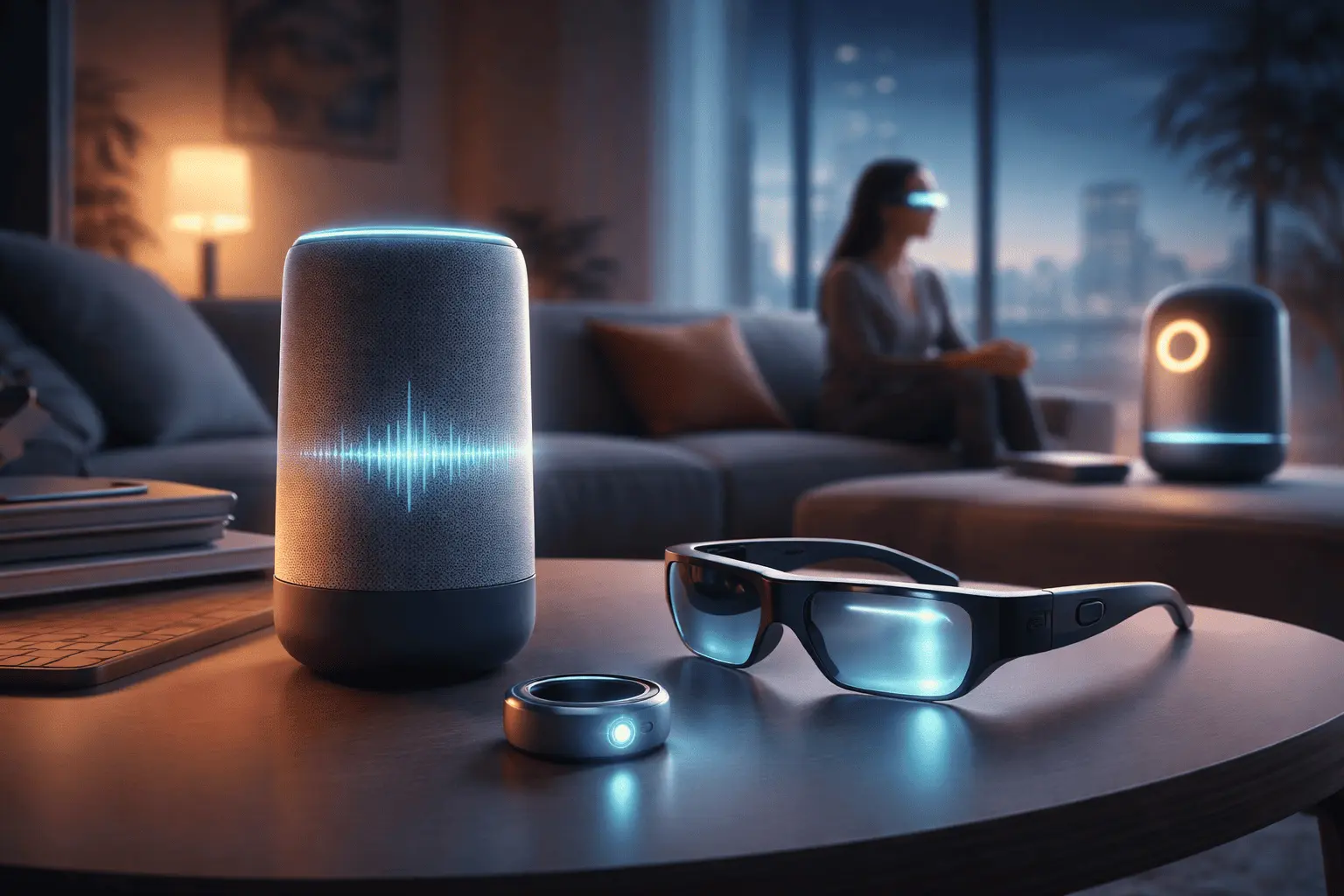
- Screenless smart speakers: Ambient AI companions for homes
- Smart glasses: Context-aware audio delivery integrated with AR
- Wearables: Rings, pendants, or earbuds capable of always-on conversational AI
This hardware strategy aligns with the design philosophy of Jony Ive, OpenAI’s hardware chief post-acquisition of io for $6.5 billion. Ive’s focus is on reducing attention addiction, allowing technology to fade into the background while remaining highly functional.
The Big Four: Audio AI Strategies Compared
| Feature / Company | OpenAI | Meta | Apple | |
|---|---|---|---|---|
| Core focus | Audio-first devices, conversational AI | Audio summaries of search & multi-turn Assistant | Spatial audio in AR/VR, ambient awareness | Privacy-first voice experiences, spatial audio |
| Current products | ChatGPT voice, prototypes of smart speakers/glasses | Google Assistant, Audio Overviews, Nest speakers | Ray-Ban smart glasses, Oculus/AR headsets | Siri, AirPods Pro spatial audio, HomePod 2 |
| Hardware integration | Smart speakers, glasses, wearables | Pixel phones, Nest speakers, earbuds | Glasses, AR/VR devices | iPhones, HomePod, AirPods |
| Key innovation | Interruptions, overlapping speech, contextual dialogue | Search summaries, multi-turn dialogue | Directional audio, ambient awareness | On-device processing, low-latency speech, privacy |
| Market timing | Early 2026 for models/devices | 2025–2026 gradual rollout | 2025–2027 expanding AR/VR audio | Incremental iOS & HomePod updates |
| Strengths | Human-like conversation, flexible ecosystem | Massive data, ecosystem integration | Immersive hardware & spatial audio | Trusted privacy, polished ecosystem |
| Challenges | Hardware adoption, user education | Context limitations outside search | Consumer adoption & privacy concerns | Slow audio-first device rollout, limited AI depth |
Analysis:
- OpenAI: Leads in multi-turn, natural dialogue and immersive AI ecosystem potential
- Google: Dominates information retrieval via spoken summaries
- Meta: Innovates in immersive spatial audio and AR/VR integration
- Apple: Prioritizes privacy, polish, and ecosystem cohesion
The Startup Factor
Beyond the Big Four, startups are experimenting with new screenless audio devices:
- Humane AI Pin: Burned through millions, ultimately became a cautionary tale of market misalignment
- Friend AI Pendant: Raises privacy and social concerns while promising life-logging and companionship
- Sandbar & Pebble Founder Rings: AI-enabled wearable rings for conversational interaction, slated for 2026
The startup scene illustrates both the promise and peril of audio-first form factors, highlighting the challenge of building devices users truly adopt.
Global Adoption Trends
- North America: Leading in smart speaker penetration and early adoption of wearable AI
- Europe: Privacy-conscious users may prefer Apple-style devices with on-device processing
- Asia-Pacific: High mobile and IoT adoption, offering fertile ground for audio-first ecosystems
- Emerging Markets: Audio-first devices may leapfrog screens in regions with lower smartphone penetration
Potential Risks
- Privacy & Security: Always-listening devices raise concerns about surveillance and data misuse.
- Cognitive Load: Continuous conversational AI could introduce mental fatigue if improperly designed.
- Adoption Barriers: Wearables and screenless devices may struggle to gain traction without clear utility.
- Accessibility: Audio interfaces must accommodate hearing-impaired users and noisy environments.
Future Outlook (2026–2030)
2026–2027: Early Adoption
- OpenAI launches first audio-first device
- Google expands Audio Overviews
- Meta develops AR/VR audio experiences
- Apple iteratively improves Siri & HomePod
2027–2028: Multitasking Integration
- AI assistants manage schedules, summarize content, and engage in overlapping dialogue
- Users experience seamless conversation without screens
2028–2029: Wearables & Ecosystem Growth
- AI rings, pendants, earbuds, and glasses enable always-on interaction
- OpenAI may dominate multi-device conversational ecosystems
2029–2030: Full Immersion
- AI follows users across environments and devices
- Screens become optional, audio-driven AI is the primary interface
- Success depends on balancing convenience, privacy, and cognitive load
Use Cases Across Industries
- Home automation: Controlling lights, appliances, security via conversational AI
- Healthcare: Patient monitoring, medication reminders, and natural health consultations
- Education: Personalized audio tutoring and interactive lessons
- Enterprise: Virtual assistants for meetings, workflow management, and real-time translation
The Post-Screen Future
By 2030, the primary human-computer interface may no longer be a screen. Interaction will be conversational, contextual, and ambient, embedded across homes, offices, wearables, and vehicles. OpenAI’s combination of advanced audio AI, multi-device ecosystems, and human-like conversational capability positions it at the forefront of this transformation.
Google, Meta, and Apple will each leverage their strengths — data, spatial audio, and privacy — to stake a claim in this emerging era. Users will gain companions, not just tools; assistants that listen, speak, and adapt seamlessly to daily life.
Final Thoughts
The move toward audio-first AI represents one of the most significant shifts in technology since the rise of the smartphone. OpenAI’s efforts, from rebuilding its audio models to developing screenless, conversational devices, signal a future where technology becomes ambient, context-aware, and deeply human-centric.
Key takeaways:
- Conversation as the core interface: OpenAI is leading in natural, multi-turn dialogue, creating assistants that feel like companions rather than tools. This approach could redefine how users interact with machines in everyday life.
- Hardware and software synergy: The next generation of audio-first devices — smart speakers, wearables, rings, and AR glasses — will rely on seamless integration between AI models and hardware. Companies that succeed will create ecosystems where AI follows users across environments.
- Big Tech competition: Google, Meta, and Apple are all making strategic moves in audio AI, but each leverages its strengths differently — data access, immersive spatial audio, or privacy and ecosystem cohesion. OpenAI’s multi-device strategy and conversational focus could give it an early advantage.
- Global adoption and accessibility: From North America to Asia-Pacific, audio-first AI has the potential to become a mainstream interface. Success will depend on addressing privacy, cognitive load, accessibility, and cultural adaptation.
- Future outlook (2026–2030): Over the next five years, screens may fade into the background while AI assistants handle multitasking, context-aware responses, and proactive engagement. The technology promises convenience, efficiency, and deeper human-machine connection, but it must be implemented responsibly.
In essence, audio-first AI is not just about better speech recognition or smarter assistants — it’s about creating a more natural, human-like interaction model. By 2030, we may live in a world where we interact with our devices more by listening and speaking than by tapping or scrolling, a transformation that has profound implications for productivity, privacy, and lifestyle.
The post-screen era is coming, and OpenAI is at the forefront — but the success of this revolution will depend not just on technology, but on thoughtful design, ethical deployment, and the ability to make AI feel less like a machine and more like a companion.