Huawei’s HarmonyOS Crosses the Survival Line: How a Sanction-Born Platform Became China’s Most Important Operating System
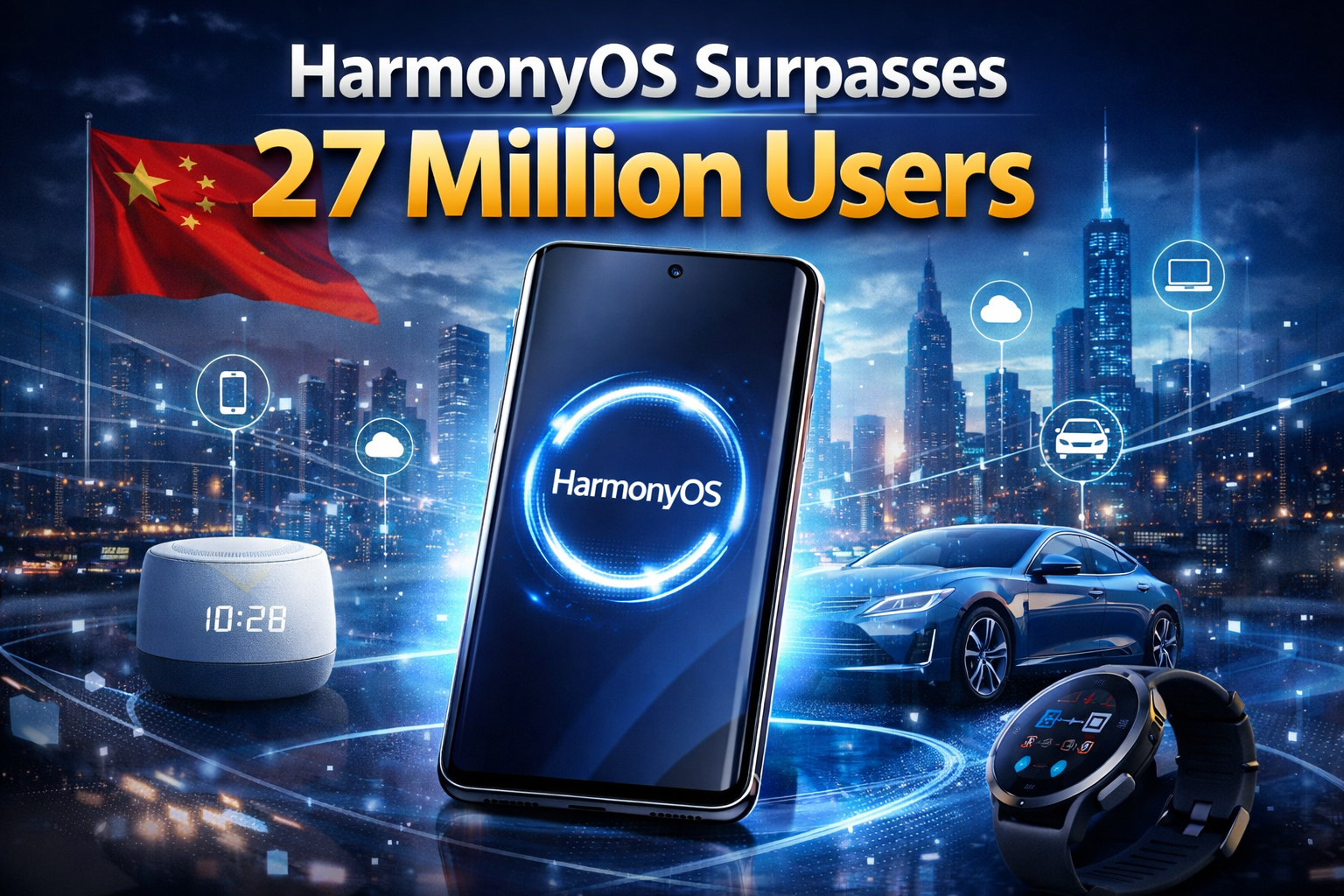
Huawei’s HarmonyOS has officially crossed what the company calls its “survival line”, reaching more than 27 million active users across its latest versions. For most operating systems, this number might seem modest in a world dominated by Android and iOS. But for Huawei, the milestone carries far greater meaning. It represents proof that an operating system born out of political pressure, technological isolation, and global skepticism has not only survived—but begun to thrive.
HarmonyOS is no longer an experiment or a contingency plan. It is now a functioning, expanding ecosystem with millions of users, millions of developers, and growing influence across China’s consumer electronics landscape. To understand why this matters, it is necessary to look beyond the numbers and examine the deeper context: how HarmonyOS emerged, why Huawei invested so heavily in it, and what its growth signals for the future of global technology platforms.
The Origins: An Operating System Born From Crisis
HarmonyOS did not begin as a direct competitor to Android or iOS. In fact, Huawei had been working quietly on alternative operating system concepts for years, long before global politics forced its hand. However, the turning point came in 2019, when the United States placed Huawei on its Entity List, citing national security concerns.
This decision effectively cut Huawei off from critical US technologies, most notably Google Mobile Services (GMS)—a core component of Android outside China. While Huawei could still technically use the open-source version of Android, the loss of Google apps severely weakened its smartphones in international markets.
For a company that had just become the world’s largest smartphone vendor, the impact was immediate and severe. Huawei faced a stark choice: retreat from the global smartphone market or build an independent software ecosystem capable of replacing Android.
HarmonyOS became that answer.
Early Skepticism and the “Android Clone” Criticism
When Huawei first publicly introduced HarmonyOS, critics were quick to dismiss it. Many analysts argued that it was little more than a rebranded version of Android, heavily modified but fundamentally dependent on Android’s architecture. Others questioned whether any new operating system could realistically challenge the entrenched dominance of Android and iOS, which together control nearly the entire global smartphone market.
Huawei responded by positioning HarmonyOS not just as a smartphone operating system, but as a distributed OS designed to run across multiple device categories. The company emphasized seamless connectivity between phones, tablets, smart TVs, wearables, cars, and home appliances—an ecosystem vision that extended far beyond traditional mobile platforms.
Still, adoption was slow at first. Outside China, Huawei’s smartphone sales collapsed. Inside China, users were cautious, developers hesitant, and the ecosystem fragile.
The Strategic Shift: From Backup Plan to Core Platform
By 2021, Huawei made a decisive move: it began transitioning its own devices from Android-based software to HarmonyOS at scale. This was no longer a fallback strategy. HarmonyOS became the default operating system for Huawei smartphones, tablets, and an expanding range of consumer electronics.
This transition was risky. Huawei was effectively asking hundreds of millions of users to trust a platform that lacked the app depth and familiarity of Android. To ease the shift, Huawei ensured compatibility with many Android applications, while simultaneously pushing developers to create native HarmonyOS apps optimized for its architecture.
The strategy worked—slowly at first, then with increasing momentum.
Crossing the “Survival Line”: Why 27 Million Users Matter
Huawei’s announcement that HarmonyOS has surpassed 27 million users across HarmonyOS 5 and HarmonyOS 6 marks a symbolic and practical turning point.
Internally, Huawei refers to this number as a “survival line”—the minimum scale required for an operating system to sustain itself. Below this threshold, developer interest fades, user engagement stagnates, and ecosystems collapse. Above it, network effects begin to take hold.
At this scale:
- Developers can justify long-term investment
- App ecosystems become self-reinforcing
- User retention improves
- Platform innovation accelerates
Huawei’s ecosystem now includes over 10 million developers, a staggering figure that underscores how deeply HarmonyOS has penetrated China’s software community.
Engagement Metrics Signal Real Usage, Not Just Installations
User numbers alone do not tell the full story. What makes HarmonyOS’s growth more compelling is the level of daily engagement reported by Huawei.
According to the company:
- More than 100,000 new HarmonyOS devices are activated every day
- Around 88 million app downloads and updates occur daily
These figures suggest that HarmonyOS is not merely installed on dormant devices but actively used by millions of consumers. High daily download activity indicates frequent app updates, ongoing development, and strong platform vitality.
HarmonyOS 5 and 6: Maturing the Platform
HarmonyOS 6 represents the latest stage in Huawei’s software evolution. Released to developers in June and to Chinese consumers in October, it builds on the foundation laid by HarmonyOS 5, which launched in late 2024.
The newer version focuses on:
- Improved system performance
- Lower latency across connected devices
- Enhanced security architecture
- Deeper integration across Huawei’s hardware ecosystem
One of the most notable additions is a cross-platform file-sharing feature, functionally similar to Apple’s AirDrop. For the first time, users can directly transfer files between Huawei and Apple devices—an unusual move that signals Huawei’s pragmatic approach to interoperability, even with competitors.
Expanding Beyond Smartphones
Unlike Android and iOS, which remain primarily phone-centric, HarmonyOS is increasingly positioned as a universal operating system.
Huawei has expanded HarmonyOS to:
- Tablets
- Smartwatches
- Smart TVs
- In-car infotainment systems
- Home appliances
- IoT devices
This cross-device strategy aligns closely with China’s broader push for domestic technology self-reliance, particularly in critical digital infrastructure. HarmonyOS is becoming less about smartphones alone and more about controlling the software layer of everyday life.
Market Share Gains in China
Independent market data reinforces Huawei’s claims. According to Counterpoint Research, HarmonyOS accounted for 17 per cent of China’s smartphone operating system market in the second quarter of the year, surpassing Apple’s iOS at 16 per cent.
This marked the sixth consecutive quarter in which HarmonyOS maintained its lead over iOS in China. While Android remains dominant with a 66 per cent share, HarmonyOS has firmly secured second place.
This achievement is especially significant given Apple’s strong brand loyalty and premium positioning in China.
Huawei’s Smartphone Comeback Fuels OS Growth
HarmonyOS’s rising adoption cannot be separated from Huawei’s rebound in the smartphone market. After years of decline following US sanctions, Huawei has staged a remarkable comeback domestically.
Research firm BCI reports that Huawei reclaimed its position as China’s top smartphone vendor in late November and early December, overtaking Apple. This surge followed the launch of the Mate 80 series, including multiple flagship models and the foldable Mate X7.
Every new Huawei smartphone sold today strengthens the HarmonyOS ecosystem, creating a virtuous cycle of hardware sales and software adoption.
What This Means for Apple and Google
While HarmonyOS is unlikely to threaten Android or iOS globally in the near term, its success in China introduces a new dynamic into the global operating system landscape.
For Apple:
- China is one of its most important markets
- Losing OS share weakens ecosystem control
- Regulatory and geopolitical risks are increasing
For Google:
- HarmonyOS demonstrates that Android is not indispensable
- Domestic alternatives can scale rapidly with state and corporate support
HarmonyOS’s rise signals that platform dominance is no longer guaranteed, particularly in geopolitically sensitive markets.
Looking Ahead: From Survival to Sustainability
Crossing the survival line does not guarantee long-term success, but it does change the conversation. HarmonyOS is no longer fighting for relevance—it is fighting for refinement, expansion, and influence.
Huawei’s next challenges will include:
- Improving app quality and depth
- Attracting global developers
- Expanding beyond China
- Navigating regulatory and political barriers
Yet one fact is now clear: HarmonyOS is real, it is growing, and it is no longer optional for anyone serious about understanding the future of technology in China.
Rethinking the Operating System: HarmonyOS at a Technical Level
To understand why HarmonyOS has moved beyond a symbolic project and into a sustainable platform, it is necessary to examine how it actually works. Huawei has repeatedly emphasized that HarmonyOS is not simply another smartphone operating system, but a distributed operating system designed to function across devices of vastly different sizes, capabilities, and use cases.
At its core, HarmonyOS is built around the idea that devices, not apps, are the primary unit of computing. Instead of each device operating as a self-contained system, HarmonyOS allows hardware to pool resources dynamically. A smartphone can provide computing power, a tablet can act as a display, a smartwatch can serve as an input device, and all of them can behave as one logical system.
This architectural philosophy sets HarmonyOS apart from Android and iOS, which are fundamentally device-centric.
The Distributed Soft Bus: The Heart of HarmonyOS
One of the most important technical components of HarmonyOS is what Huawei calls the Distributed Soft Bus. This layer allows devices to discover one another automatically, establish secure connections, and share capabilities in real time.
From a user perspective, this enables features such as:
- Dragging an app from a phone to a tablet and continuing it instantly
- Using a smartphone camera as a webcam for a laptop or TV
- Controlling multiple smart devices from a single interface
- Seamless file transfers without pairing friction
From a developer perspective, the distributed soft bus abstracts away much of the complexity involved in multi-device development. Developers can write applications that are inherently cross-device, without manually coding communication logic for each hardware combination.
This is a key reason Huawei has been able to attract millions of developers despite the platform’s relative youth.
Microkernel Design and Security Ambitions
HarmonyOS also differs from Android and iOS in its microkernel-inspired design, at least in parts of the system. While Android relies heavily on a monolithic Linux kernel, HarmonyOS isolates core system services more aggressively.
Huawei argues that this approach offers:
- Reduced attack surface
- Stronger permission isolation
- Higher fault tolerance
- Better real-time performance
For Chinese regulators and enterprise customers, security is not just a technical issue—it is a strategic priority. HarmonyOS’s architecture aligns closely with China’s emphasis on domestic control over critical software infrastructure, especially in government, finance, and industrial systems.
This has allowed HarmonyOS to gain traction not only in consumer electronics but also in enterprise and public-sector deployments.
Compatibility With Android: A Necessary Compromise
Despite Huawei’s long-term ambition to move away from Android entirely, HarmonyOS has relied heavily on Android compatibility layers to accelerate adoption. This decision has been both pragmatic and controversial.
On one hand, Android compatibility:
- Allows existing apps to run with minimal changes
- Reduces friction for users switching platforms
- Encourages developers to experiment without full rewrites
On the other hand, critics argue that this undermines Huawei’s claim of full independence. Huawei has responded by gradually shifting emphasis toward native HarmonyOS applications, offering performance, UI, and multi-device advantages that Android apps cannot fully replicate.
HarmonyOS 5 and 6 represent a turning point in this strategy, with Huawei pushing developers toward native frameworks and discouraging long-term reliance on Android compatibility.
The Developer Economy: Why 10 Million Developers Matter
Huawei’s claim of over 10 million developers in the HarmonyOS ecosystem is one of the most striking data points in its announcements. While this figure includes developers at varying levels of activity, it reflects a massive mobilization of China’s software community.
Several factors have contributed to this scale:
1. Financial Incentives
Huawei has invested billions of dollars in developer subsidies, grants, and revenue-sharing programs. Developers building native HarmonyOS apps receive preferential promotion, technical support, and monetization opportunities.
2. Government Alignment
Local governments across China have encouraged HarmonyOS adoption in education, public services, and smart city projects. This has created demand for HarmonyOS skills and applications, particularly outside major tech hubs.
3. Market Access
With Huawei reclaiming its position as a top smartphone vendor in China, developers know that HarmonyOS apps now have access to tens of millions of active users—enough to justify serious investment.
App Quality vs App Quantity
One of the persistent challenges for HarmonyOS has been app quality parity with Android and iOS. While the number of available apps has grown rapidly, users often judge platforms based on:
- Depth of functionality
- Update frequency
- UI polish
- Integration with system features
Huawei has responded by prioritizing partnerships with major Chinese platforms in:
- Payments
- Social media
- E-commerce
- Transportation
- Entertainment
Rather than attempting to replicate the entire Android ecosystem overnight, Huawei focused on ensuring that the top 1,000 apps used by Chinese consumers are fully optimized for HarmonyOS. This strategy has proven effective in reducing friction for everyday users.
HarmonyOS vs Android: A Structural Comparison
Although HarmonyOS and Android coexist within Huawei’s ecosystem, the two platforms reflect fundamentally different priorities.
Android’s Strengths
- Global app ecosystem
- Mature developer tools
- Deep integration with Google services (outside China)
- Massive hardware diversity
HarmonyOS’s Strengths
- Deep hardware-software integration
- Superior multi-device coordination
- Strong domestic regulatory alignment
- Optimized performance on Huawei hardware
In China, where Google services are absent, Android loses many of its ecosystem advantages. This creates a rare environment in which a domestic platform like HarmonyOS can compete on more equal footing.
HarmonyOS vs iOS: Control vs Consistency
Apple’s iOS remains the gold standard for:
- UI consistency
- App quality
- Long-term software support
- Ecosystem lock-in
However, Apple’s closed ecosystem limits flexibility, particularly in cross-brand interoperability. HarmonyOS, by contrast, has pursued a more open strategy within China, partnering with appliance makers, car manufacturers, and IoT vendors.
The introduction of cross-platform file sharing with Apple devices in HarmonyOS 6 is a telling example. Rather than isolating itself, Huawei is selectively opening compatibility where it benefits user adoption.
Hardware as the Catalyst: Why Huawei’s Devices Matter
Operating systems do not succeed in isolation. HarmonyOS’s growth is inseparable from Huawei’s hardware resurgence.
The Mate 80 series represents a critical inflection point. By delivering competitive performance, advanced camera systems, and strong battery efficiency, Huawei has proven that it can still build flagship devices despite restricted access to advanced semiconductor technologies.
Every Mate smartphone sold:
- Adds a new HarmonyOS user
- Strengthens developer incentives
- Expands the ecosystem’s data and feedback loop
This hardware-software synergy mirrors Apple’s model, albeit under far more constrained conditions.
The Role of Domestic Semiconductors
Huawei’s operating system strategy cannot be separated from its semiconductor ambitions. While the company continues to face restrictions on cutting-edge chip manufacturing, it has made progress in optimizing software to compensate for hardware limitations.
HarmonyOS is increasingly tuned to:
- Reduce power consumption
- Optimize task scheduling
- Improve AI inference efficiency
This software-led optimization has allowed Huawei devices to remain competitive even without access to the most advanced process nodes. In effect, HarmonyOS has become a tool for hardware resilience.
Market Share Momentum: Beyond a Temporary Spike
Skeptics have argued that HarmonyOS’s market share gains could be temporary, driven by patriotic buying or short-term hardware cycles. However, the data suggests a more structural shift.
Maintaining a lead over iOS for six consecutive quarters indicates sustained adoption rather than a one-off surge. Moreover, Android’s dominance in China is increasingly fragmented across vendors, while HarmonyOS benefits from unified control and direction.
This consolidation gives Huawei leverage that few Android OEMs possess.
The Psychological Shift: From Skepticism to Acceptance
Perhaps the most important change is not technical or numerical, but psychological. In its early years, HarmonyOS was often perceived as a compromise—something users tolerated rather than embraced.
Today, that perception is changing. For many Chinese consumers:
- HarmonyOS is no longer “different,” it is “normal”
- App availability is “good enough”
- Performance meets or exceeds expectations
- Ecosystem integration offers tangible benefits
This normalization is critical. Once users stop thinking about the operating system as a limitation, adoption accelerates naturally.
Strategic Implications for China’s Tech Independence
HarmonyOS is more than a corporate product; it is a strategic asset. For China, the platform represents:
- Reduced reliance on foreign software
- Greater control over data flows
- Enhanced resilience against sanctions
- A template for domestic alternatives in other sectors
This alignment between corporate ambition and national strategy gives HarmonyOS a level of institutional support that few operating systems enjoy.
Risks and Constraints Still Remain
Despite its progress, HarmonyOS faces significant challenges:
- Limited international adoption
- Continued reliance on Android compatibility
- App ecosystem gaps in specialized categories
- Ongoing geopolitical uncertainty
Huawei must also balance openness with control—too much restriction could stifle innovation, while too much openness could weaken platform coherence.
From Survival to Strategy
Crossing the survival line has transformed HarmonyOS from a defensive measure into a strategic platform. The next phase is no longer about proving that the OS can exist, but about defining what kind of ecosystem it will become.
Will HarmonyOS remain primarily a China-focused system, or will it evolve into a regional or global platform? Can it attract developers outside China? Will Huawei maintain momentum as competition intensifies?
These questions will define HarmonyOS’s future.
Technology and Power: Why Operating Systems Matter Geopolitically
Operating systems are often discussed as consumer products, but at scale they function more like strategic infrastructure. Whoever controls the operating system controls:
- Application distribution
- Data flows
- Security standards
- Developer incentives
- Platform economics
For decades, this control has been concentrated in the hands of US-based companies, primarily Google and Apple. HarmonyOS represents one of the most serious attempts to break that concentration—not through regulation, but through technological substitution.
Huawei’s success in pushing HarmonyOS past its survival line marks a shift in how power is distributed in the global digital ecosystem.
Sanctions as a Catalyst, Not a Constraint
The US sanctions imposed on Huawei were designed to slow the company’s technological progress by cutting it off from key suppliers and platforms. In the short term, they worked. Huawei’s international smartphone business collapsed, and its global market share evaporated.
In the long term, however, those same sanctions forced Huawei to:
- Build its own operating system
- Reinvest in domestic supply chains
- Develop independent software frameworks
- Rethink platform dependence
HarmonyOS is the most visible result of that forced transformation. Rather than being a weakened Android derivative, it has evolved into a platform optimized for a specific political, regulatory, and market environment.
Digital Sovereignty: A Core National Priority
China’s concept of digital sovereignty emphasizes control over data, platforms, and critical infrastructure. HarmonyOS aligns closely with this vision by offering:
- Domestic governance over system updates
- Localized security standards
- Reduced exposure to foreign regulatory pressure
- Greater visibility into software supply chains
As governments around the world become more sensitive to data security and platform dependency, HarmonyOS’s development offers a blueprint for how nations might reclaim control over digital infrastructure.
This does not mean HarmonyOS will be exported wholesale as a geopolitical tool—but it does mean that software independence is now seen as achievable, not hypothetical.
The China-Only Scenario: Stability Without Scale
One possible future for HarmonyOS is that it remains primarily a China-focused operating system, serving domestic consumers, enterprises, and public institutions.
In this scenario:
- HarmonyOS continues to grow steadily within China
- Developer support remains strong domestically
- Integration with Chinese services deepens
- Global expansion remains limited
This path offers stability and sustainability. China’s market alone is large enough to support a major operating system. With hundreds of millions of devices sold annually, HarmonyOS does not need global dominance to remain viable.
However, the downside is limited innovation diversity. Platforms thrive on exposure to different markets, cultures, and use cases. A purely domestic focus risks long-term stagnation.
The Regional Expansion Scenario: Asia and the Global South
A more ambitious path involves regional expansion, particularly in:
- Southeast Asia
- South Asia
- The Middle East
- Africa
- Parts of Latin America
These markets share several characteristics:
- High smartphone growth potential
- Less entrenched loyalty to Apple
- Greater price sensitivity
- Growing interest in alternatives to US platforms
Huawei already has brand recognition in many of these regions. If HarmonyOS can be positioned as a flexible, affordable, and well-supported platform, it could gain traction—especially in partnership with local manufacturers and governments.
This scenario would not require HarmonyOS to displace Android entirely, but to coexist as a viable alternative.
The Global Fragmentation Scenario: A Multi-OS World
The most transformative scenario is one in which the global technology ecosystem fragments into multiple regional platform blocs.
In such a world:
- Android and iOS dominate Western markets
- HarmonyOS dominates China
- Hybrid or localized platforms emerge elsewhere
- Developers build for multiple ecosystems
This fragmentation would mark the end of the “two-OS world” that has defined mobile computing for over a decade.
HarmonyOS’s success would then be measured not by global market share, but by strategic relevance—its ability to shape standards, influence norms, and provide leverage in negotiations over technology governance.
Risks of Platform Isolation
Fragmentation comes with significant risks. For HarmonyOS, the greatest danger is platform isolation.
Key risks include:
- Reduced access to global innovation
- Difficulty attracting international developers
- Slower adoption of global standards
- Increased maintenance costs for developers
Huawei is aware of these risks, which explains its selective openness—such as enabling file transfers with Apple devices and supporting international development tools.
The challenge lies in balancing sovereignty with interoperability.
The Developer Dilemma: Build Once, Deploy Everywhere?
Developers are pragmatic. They prioritize platforms that offer:
- Large user bases
- Predictable monetization
- Stable APIs
- Long-term viability
HarmonyOS has cleared the first hurdle by crossing the survival line. The next challenge is to reduce the incremental cost of supporting yet another platform.
Huawei’s strategy focuses on:
- Unified development frameworks
- Cross-device abstractions
- Tooling that minimizes rewrites
- Financial incentives
If successful, HarmonyOS could position itself not as an additional burden, but as a value multiplier—especially for developers targeting multi-device experiences.
Enterprise and Government Adoption: The Quiet Growth Engine
While consumer smartphones attract headlines, HarmonyOS’s most durable growth may come from enterprise and government adoption.
In these sectors:
- Long-term stability matters more than brand perception
- Security and compliance are paramount
- Platform lock-in is often a feature, not a bug
HarmonyOS has already been deployed in:
- Smart city infrastructure
- Public service terminals
- Industrial monitoring systems
- Transportation and automotive platforms
These deployments provide steady revenue, predictable usage, and institutional legitimacy—key ingredients for long-term platform sustainability.
Automotive and IoT: The Next Battleground
Smartphones may have given HarmonyOS its user base, but automotive systems and IoT may define its future.
Cars are rapidly becoming:
- Software-defined platforms
- Data-generating machines
- Extension of digital ecosystems
Huawei’s partnerships with automakers allow HarmonyOS to embed itself deeply into vehicle operating systems, navigation, infotainment, and connectivity layers.
Similarly, IoT devices—from appliances to industrial sensors—are multiplying rapidly. HarmonyOS’s distributed architecture is particularly well-suited to managing such environments.
If Huawei succeeds here, HarmonyOS could become more influential outside phones than within them.
Can Apple or Google Replicate This Model?
Apple’s ecosystem is tightly controlled, vertically integrated, and globally consistent. This has been its greatest strength—and its greatest limitation.
Google’s Android is open, but fragmented and heavily dependent on Google services, which limits its appeal in regulated markets.
Neither company has shown strong interest in building nationally aligned operating systems tailored to sovereign requirements. This leaves a strategic gap that HarmonyOS fills almost by default.
HarmonyOS is not trying to beat Apple or Google at their own game. It is playing a different game altogether.
Measuring Success: Redefining the Metrics
Traditional metrics like global market share may not be the best way to evaluate HarmonyOS.
More relevant indicators include:
- Developer retention rates
- App engagement depth
- Multi-device usage frequency
- Enterprise deployments
- Ecosystem revenue sustainability
By these measures, HarmonyOS’s progress looks far more substantial than raw user numbers suggest.
The Psychological Endgame: Normalization of Multipolar Platforms
Perhaps the most lasting impact of HarmonyOS is psychological.
For years, the assumption was that:
- Only US companies could build global platforms
- New operating systems could not survive
- Ecosystem lock-in was irreversible
HarmonyOS challenges all three assumptions.
Even if it never becomes a global standard, it has proven that platform dominance can be contested, especially when technology, policy, and market forces align.
Lessons for the Global Tech Industry
HarmonyOS offers several lessons that extend far beyond Huawei:
- Resilience beats optimization
Systems built for efficiency alone are vulnerable to disruption. - Ecosystems are political as well as technical
Platform strategy must account for regulation and geopolitics. - Scale is necessary, but relevance is decisive
An OS does not need billions of users to matter. - Hardware still matters
Control over devices accelerates software adoption.
Final Verdict: Survival, Sustainability, or Something More?
HarmonyOS has clearly moved beyond survival. It has achieved sustainability within China and is laying the groundwork for broader influence.
Whether it becomes:
- A permanent domestic standard
- A regional alternative
- A pillar of a fragmented global ecosystem
will depend on Huawei’s ability to maintain momentum, openness, and innovation under continued geopolitical pressure.
What is already certain is this: HarmonyOS is no longer a footnote in the story of mobile operating systems. It is a case study in how constraints can reshape ambition—and how survival can become strategy.
Google Pixel vs Apple iPhone vs Huawei (HarmonyOS): 2025–2030 Outlook Comparison
| Category | Google Pixel | Apple iPhone | Huawei (HarmonyOS) | 2025–2030 Outlook |
|---|---|---|---|---|
| Operating System | Android (Pixel UI) | iOS | HarmonyOS | OS competition shifts from features to ecosystem control and AI depth |
| OS Ownership | Apple | Huawei | Vertically owned OS platforms gain strategic advantage | |
| Core Strategy | AI-first Android reference | Premium, closed ecosystem | Sovereign, distributed ecosystem | Platforms align more closely with geopolitics and regulation |
| Global Availability | Wide but selective | Truly global | Primarily China | Regional OS dominance becomes more common |
| Primary Market Strength | US, EU, Japan | US, China, EU | China | Asia remains the key growth battleground |
| Ecosystem Control | Partial | Full | Near-full (domestic) | Control over software + hardware defines resilience |
| App Ecosystem Size | Massive | Massive | Large, regional | Multi-platform development becomes standard |
| Developer Base | Global Android devs | Global iOS devs | Mostly Chinese devs | Developers prioritize platforms with predictable revenue |
| Multi-Device Integration | Improving | Market-leading | Rapidly improving | Cross-device experiences become default expectations |
| Cross-Device Features | Nearby Share, Fast Pair | AirDrop, Continuity | Super Device, distributed apps | OS differentiation shifts to orchestration, not apps |
| AI Integration | Deep Gemini integration | Expanding Apple Intelligence | System-level optimization | On-device AI becomes mandatory |
| Security Model | Open but hardened | Closed, highly controlled | Microkernel-based | Security standards tighten globally |
| Privacy Positioning | Mixed | Core brand identity | Security + sovereignty | Privacy becomes a competitive lever |
| Chip Strategy | Tensor (outsourced) | Apple Silicon (in-house) | HiSilicon (restricted) | Software optimization offsets hardware limits |
| Hardware–Software Synergy | Moderate | Best-in-class | Improving rapidly | Vertical integration outperforms modular models |
| File Sharing & Interop | Android ecosystem | Mostly Apple-only | Apple ↔ HarmonyOS | Interoperability pressure increases |
| IoT & Smart Home | Google Home | HomeKit | Smart city & industrial IoT | OS expands beyond phones |
| Automotive Integration | Android Auto | CarPlay | In-car OS platforms | Vehicles become major OS endpoints |
| Enterprise & Government Use | Limited | Limited | Strong (China) | Government-backed platforms grow quietly |
| OS Market Share (China) | Part of Android ~66% | ~16% | ~17% | China remains the only market with 3 viable OSes |
| Geopolitical Exposure | Low | Low | High | Politics increasingly shape tech roadmaps |
| Key Advantage | AI-first Android leadership | Premium ecosystem stability | Sovereign platform control | Strategic resilience outweighs raw scale |
| Key Risk | Android fragmentation | Regulatory pressure | Global isolation | Fragmented global tech ecosystem |
| Long-Term Trajectory | Niche premium Android leader | Stable global premium leader | Dominant domestic platform | World moves toward multi-OS reality |
Final Thoughts
The comparison between Google Pixel, Apple iPhone, and Huawei’s HarmonyOS ecosystem highlights a deeper transformation underway in the global technology landscape. This is no longer just a competition between smartphones or operating systems—it is a contest over control, resilience, and long-term strategic influence.
Apple enters the 2025–2030 period from a position of strength. Its vertically integrated model, premium brand power, and tightly controlled ecosystem give it unmatched stability. While growth may moderate and regulatory pressure may rise, Apple’s ability to retain users and monetize its platform ensures that iOS will remain the world’s most dependable consumer operating system for years to come.
Google Pixel occupies a very different role. It is not designed to dominate in volume, but to define Android’s future direction, particularly in artificial intelligence. Pixel’s influence will continue to outweigh its sales numbers, shaping how Android evolves across hundreds of partner devices. Its biggest challenge is not relevance, but scale and fragmentation—limitations inherent to Google’s more open ecosystem.
Huawei and HarmonyOS represent the most unconventional and strategically significant path. What began as a defensive response to sanctions has evolved into a self-sustaining, domestically dominant platform. By crossing its survival line and embedding itself across smartphones, vehicles, IoT devices, and public infrastructure, HarmonyOS has proven that alternative operating systems can succeed under the right conditions. Its future may be geographically constrained, but its strategic importance—especially within China—will continue to grow.
Looking ahead, the most important shift is not which platform wins globally, but the fact that the world is moving toward a multi-OS, multipolar reality. The era of unquestioned platform dominance is fading. In its place is a more fragmented, politically influenced, and regionally defined technology ecosystem—one in which Apple, Google, and Huawei each play fundamentally different, but equally consequential, roles.