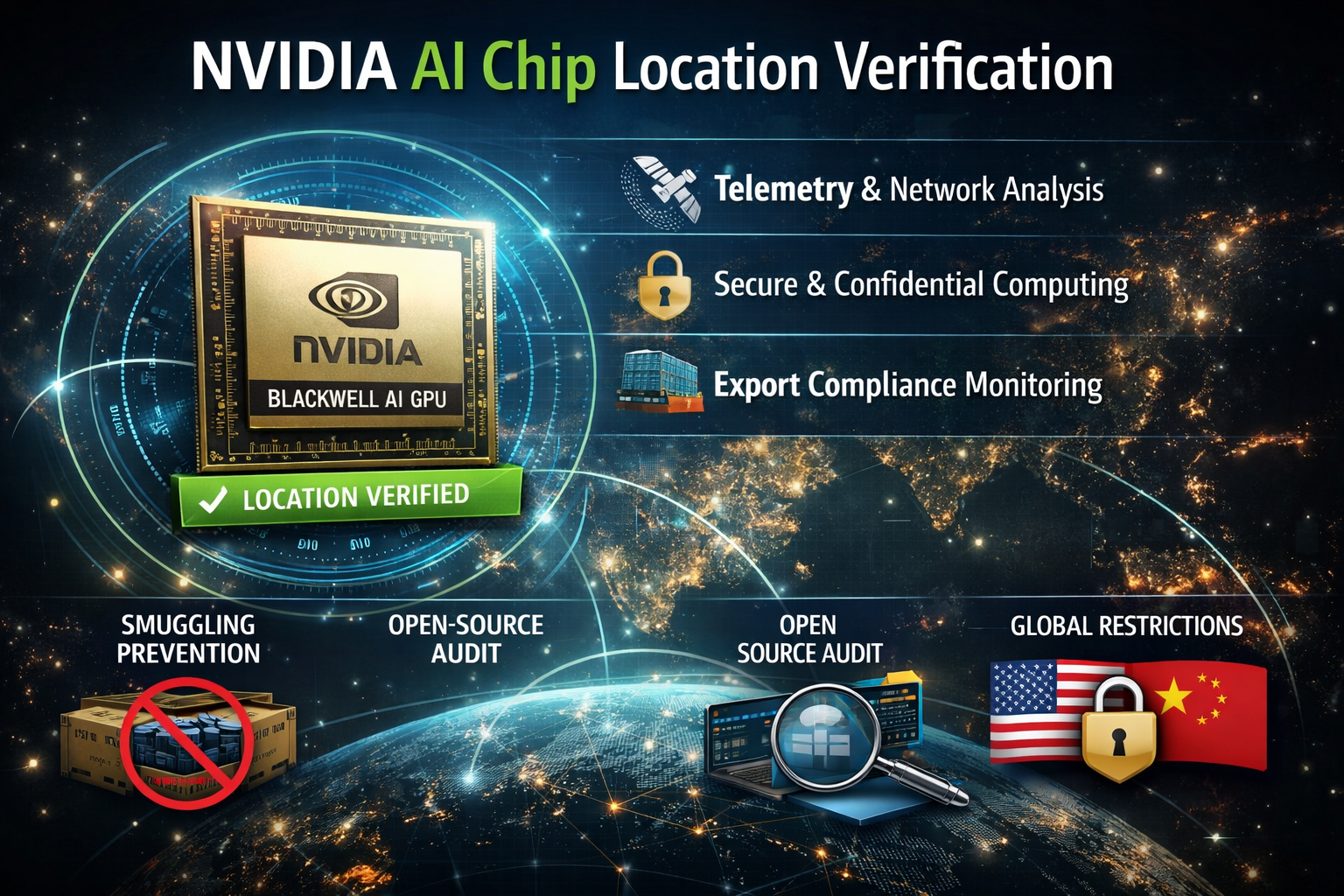
Nvidia has introduced a software-based location verification system for its AI chips, designed to prevent high-performance GPUs from being illegally exported to countries with restricted access. Confirmed on December 10, 2025, the system addresses growing concerns around AI chip security, regulatory compliance, and international smuggling.
The technology estimates the geographic location of GPUs in operation, using GPU telemetry and confidential computing. It measures performance metrics and network latency between the chip and Nvidia-managed servers, providing approximate location without using GPS. This ensures privacy, security, and compliance for enterprise customers.
How the Technology Works
The system is built on GPU telemetry, which monitors fleet performance, operational health, and computational integrity in large-scale data centers. Nvidia’s verification software adds a location detection layer that:
- Monitors GPU health, performance, and integrity.
- Uses network latency to approximate chip location.
- Collects telemetry data in read-only mode, with no ability to control or disable GPUs.
Nvidia emphasizes that the system is non-intrusive. There is no kill switch or backdoor, and customers retain complete control of their hardware.
To build trust, Nvidia will release the software as open-source, allowing independent security researchers to review and validate the system.
Deployment on Blackwell GPUs
The feature will first be available on Nvidia’s Blackwell architecture, which includes:
- Advanced telemetry and fleet monitoring.
- Hardware-based attestation for chip integrity.
- Confidential computing support for secure processing.
- Optional location verification to meet export compliance requirements.
While Blackwell is the first architecture to fully support the system, Nvidia is exploring adaptation for older GPUs, including Hopper and Ampere, which have more limited telemetry and attestation features.
Blackwell vs Hopper vs Ampere: Detailed Comparison
| Feature / Specification | Blackwell | Hopper | Ampere |
|---|---|---|---|
| Launch Year | 2025 | 2022 | 2020 |
| Target Workload | AI/ML training & inference, data centers | AI/HPC workloads | Cloud & HPC, AI workloads |
| Process Node | 4nm | 5nm | 7nm |
| Transistor Count | ~90B | ~80B | ~54B |
| GPU Telemetry | Advanced with location verification | Fleet health & performance | Basic monitoring |
| Confidential Computing | Full support | Partial support | Limited |
| Attestation | Hardware-based, anti-tamper | Hardware-based, less robust | Software-level, minimal |
| Location Verification | Optional software agent | Not supported | Not supported |
| Open-Source Compliance Tools | Planned | Limited | Minimal |
| Memory Type / Bandwidth | HBM3e / up to 4 TB/s | HBM3 / up to 3.2 TB/s | HBM2e / up to 2 TB/s |
| Peak AI Performance | 2–2.5x Hopper | 1.5x Ampere | Baseline |
Key Takeaways:
- Blackwell integrates advanced security, telemetry, and compliance tools.
- Hopper focuses on AI performance with basic fleet monitoring.
- Ampere is suitable for cloud and HPC workloads but lacks compliance features.
Timeline of AI Chip Export Restrictions
- 2018 – U.S. tightens export controls for AI and supercomputing chips.
- 2019 – Huawei added to Entity List; Nvidia requires licenses for restricted sales.
- 2020 – Licensing introduced for AI chips above performance thresholds; end-user reporting mandated.
- 2021 – China issues regulations limiting foreign technology with potential “backdoors.”
- 2022 – U.S. expands restrictions to include H100 GPUs; verification of end-use required.
- 2023 – EU and South Korea align compliance rules with U.S. export controls.
- 2024 – DOJ uncovers $160M smuggling network; calls for verification solutions grow.
- Early 2025 – Congress and White House push chipmakers to implement location verification.
- Mid 2025 – Trump administration approves H200 exports to China under strict conditions.
- December 2025 – Nvidia announces software-based location verification for Blackwell GPUs.
Case Studies: Smuggling Attempts and Law Enforcement
1. Operation Gatekeeper
- Date: December 2025
- Details: U.S. authorities dismantled a network exporting $160M+ of Nvidia GPUs to China.
- Methods: Straw purchasers, relabeling, falsified export forms.
- Outcome: Defendants face up to 20 years in prison.
2. Straw Purchaser Ring
- Details: Four individuals exported hundreds of GPUs to China via Malaysia and Thailand using fake companies and false paperwork.
3. ALX Solutions Case
- Timeline: 2022–2025
- Details: Two Chinese nationals exported tens of millions of dollars of H100 and RTX 4090 GPUs to China, routing shipments through Singapore and Malaysia.
4. Singapore Regional Crackdown
- Date: March 2025
- Details: Three men arrested for misrepresenting GPU shipments intended for Southeast Asia, possibly destined for China.
5. Law Enforcement Tactics
- Authorities embedded covert trackers in server shipments to monitor illegal diversions before products reached prohibited markets.
These cases demonstrate the scale, sophistication, and duration of illegal AI chip smuggling, underscoring the need for tools like Nvidia’s location verification software.
Industry and Geopolitical Implications
The system responds to multiple pressures:
- Regulatory compliance: Meets calls from U.S. lawmakers to prevent illegal exports.
- Enterprise security: Enables fleet monitoring without exposing sensitive data.
- Global trust: Open-source software allows auditing by third parties.
- Geopolitical context: Prevents chips from reaching restricted markets amid U.S.–China tensions.
Experts suggest Nvidia’s approach could set a global standard for AI hardware governance, balancing performance, security, and regulatory compliance.
Looking Ahead
As AI becomes central to industries from autonomous vehicles to cloud computing, secure and lawful deployment of GPUs is critical. Nvidia’s location verification system represents a practical solution to smuggling, integrating advanced telemetry, attestation, and privacy-conscious tracking.
By combining technology, transparency, and open-source auditing, Nvidia demonstrates a path forward for responsible AI hardware management, showing how companies can protect products and global technology ecosystems without compromising enterprise control.