For years, the evolution of gaming monitors followed a predictable pattern. Resolution increased, refresh rates climbed, and panel technologies slowly improved. Yet despite those advancements, the fundamental experience remained largely unchanged. Gamers still adjusted themselves to the screen—altering posture, distance, brightness, and color profiles—rather than the screen adapting to them.
With the unveiling of its 2026 Odyssey monitor lineup, Samsung appears determined to disrupt that long-standing dynamic. Instead of incremental upgrades, the company is introducing displays that actively respond to user movement, gameplay type, and performance demands. At the center of this strategy is a bold claim: the world’s first 6K glasses-free 3D gaming monitor, supported by eye tracking, adaptive depth control, and unprecedented refresh rate flexibility.
Taken as a whole, Samsung’s new Odyssey range is not merely faster or sharper—it is fundamentally more responsive to how people actually play games.
A Shift From Passive Displays to Adaptive Systems
Traditionally, monitors have functioned as passive output devices. Once configured, they remained static, regardless of what the user was doing. Competitive shooters, cinematic RPGs, productivity tasks, and media consumption all relied on the same fixed behavior.
Samsung’s 2026 Odyssey lineup challenges that model. Rather than locking users into a single operating mode, the new monitors are built around dynamic adaptability. In practice, this means displays that can alter resolution, refresh rate, depth perception, and visual behavior in real time, depending on the scenario.
This concept underpins nearly every product in the lineup, but it is most clearly realized in the flagship Odyssey 3D G90XH.
Odyssey 3D G90XH: Introducing Practical Glasses-Free 3D Gaming
At a glance, the Odyssey 3D G90XH already stands out. It features a 32-inch IPS panel with a native resolution of 6,144 × 3,456, placing it firmly within ultra-premium territory. However, the headline feature is not resolution alone—it is the ability to render true 3D visuals without glasses.
Unlike earlier attempts at consumer 3D, Samsung’s solution does not rely on fixed viewing zones or static lenticular lenses. Instead, it uses real-time eye tracking, allowing the monitor to continuously adjust depth and perspective as the user moves.
As a result, the 3D effect remains stable even when the viewer shifts position, leans back, or tilts their head. This is a critical improvement over past technologies, which often broke immersion the moment the user moved slightly off center.
Furthermore, Samsung emphasizes that this system is designed to reduce common 3D drawbacks, such as eye strain, motion sickness, and visual fatigue—issues that historically prevented long gaming sessions on 3D displays.
Understanding the Importance of Eye Tracking
Eye tracking is not simply an enhancement—it is the foundation of Samsung’s 3D implementation. By constantly monitoring the user’s eye position, the display can dynamically recalculate the parallax effect, ensuring accurate depth cues at all times.
Consequently, foreground objects appear more pronounced, background elements recede naturally, and spatial relationships feel consistent. Rather than exaggerating depth for effect, Samsung’s approach prioritizes visual coherence, which is essential for gameplay rather than passive viewing.
In addition, eye tracking enables adaptive depth tuning, meaning the intensity of the 3D effect can be adjusted to suit different content types or personal comfort preferences.
Software Support and Developer Collaboration
Hardware alone is not sufficient to establish a new display category. Recognizing this, Samsung has partnered with game studios to ensure native support for its 3D system.
At launch, confirmed compatible titles include:
- The First Berserker: Khazan
- Lies of P: Overture
- Stellar Blade
These games have been optimized to leverage depth separation, object layering, and environmental scale without compromising performance or clarity.
Additionally, Samsung includes 2D-to-3D conversion, allowing supported content to benefit from depth effects even if it was not originally designed for 3D. While native support delivers the best results, this feature broadens usability and reduces reliance on a limited content library.
Dual Mode Explained: One Monitor, Multiple Identities
Beyond immersion, Samsung places heavy emphasis on versatility. The Odyssey 3D G90XH incorporates a Dual Mode system, effectively allowing the monitor to function as two displays in one.
In its high-fidelity configuration, the panel runs at 6K resolution with a 165Hz refresh rate. This mode is optimized for visually rich titles, open-world exploration, simulation games, and cinematic experiences where detail and clarity matter most.
However, when responsiveness becomes the priority, Dual Mode enables the monitor to switch to 3K resolution at up to 330Hz. This significantly reduces GPU load while doubling motion clarity, making it better suited for fast-paced competitive games.
Crucially, this transition is designed to be seamless, eliminating the need to manually reconfigure multiple settings or profiles.
Motion Clarity and Connectivity
To complement its adaptive performance, the Odyssey 3D G90XH includes a 1ms grey-to-grey response time, ensuring minimal motion blur even at high refresh rates.
Connectivity is equally forward-looking. With HDMI 2.1 and DisplayPort 2.1, the monitor supports the bandwidth required for extreme resolutions and refresh rates, positioning it well for current and next-generation GPUs.
Taken together, these specifications suggest that Samsung expects users to keep these monitors for multiple hardware upgrade cycles.
Odyssey G6: Pushing Competitive Gaming to the Extreme
While the Odyssey 3D targets immersion and versatility, Samsung’s Odyssey G6 (G60H) is unapologetically focused on speed.
Featuring a 27-inch QHD panel, the G6 delivers a native refresh rate of 600Hz, already placing it among the fastest monitors ever announced. Yet Samsung goes even further.
Through Dual Mode, the G6 can reach a staggering 1,040Hz refresh rate at reduced resolution. This level of performance is designed for professional esports players, where reaction time and motion clarity can provide measurable advantages.
To ensure stability at such speeds, Samsung integrates:
- AMD FreeSync Premium Pro
- G-Sync compatibility
- HDR10+ Gaming
These technologies help synchronize the display with the GPU, reducing tearing and stutter even under extreme frame rates.
Odyssey G8 Series: Premium Options Without Compromise
Recognizing that not every gamer wants 3D or extreme refresh rates, Samsung has expanded the Odyssey G8 lineup to cover multiple premium use cases.
Options include:
- A 32-inch 6K IPS Odyssey G8, prioritizing sharpness and workspace immersion
- A 27-inch 5K IPS model, offering a balance between resolution and size
- A 32-inch Odyssey OLED G8, featuring QD-OLED technology, 4K resolution, and 240Hz refresh rate
The OLED variant stands out for its deep blacks, high contrast, and glare-free coating. With VESA DisplayHDR True Black 500 and HDR10+ Gaming, it targets users who value image quality as much as performance.
Additionally, USB-C power delivery up to 98W allows the OLED G8 to double as a productivity and laptop-centric display.
A Broader Industry Implication
Samsung’s 2026 Odyssey lineup does more than introduce new products—it challenges how the industry defines monitor innovation.
Instead of focusing solely on static specifications, Samsung is emphasizing context-aware displays that adapt dynamically. This approach aligns closely with broader trends in computing, where hardware increasingly responds to user behavior rather than fixed presets.
If successful, these ideas could influence future designs across the industry, pushing competitors to explore eye tracking, adaptive resolution, and real-time performance scaling.
Looking Toward CES 2026 and Beyond
Samsung plans to showcase the full Odyssey 2026 lineup at CES 2026, where hands-on demonstrations will provide critical insight into comfort, usability, and real-world performance.
The long-term success of 6K glasses-free 3D gaming will depend on developer adoption, software refinement, and user comfort during extended sessions. Nevertheless, Samsung has clearly laid the groundwork for a new category of premium displays.
Pricing and regional availability have yet to be announced, including confirmation for markets such as Australia.
What is already certain, however, is that the gaming monitor conversation is changing. Resolution and refresh rate still matter, but intelligence, adaptability, and user-centric design are becoming equally important.
Samsung’s latest Odyssey monitors suggest that the future of gaming displays is no longer about how much you can adjust your setup—but how well the screen adjusts to you.
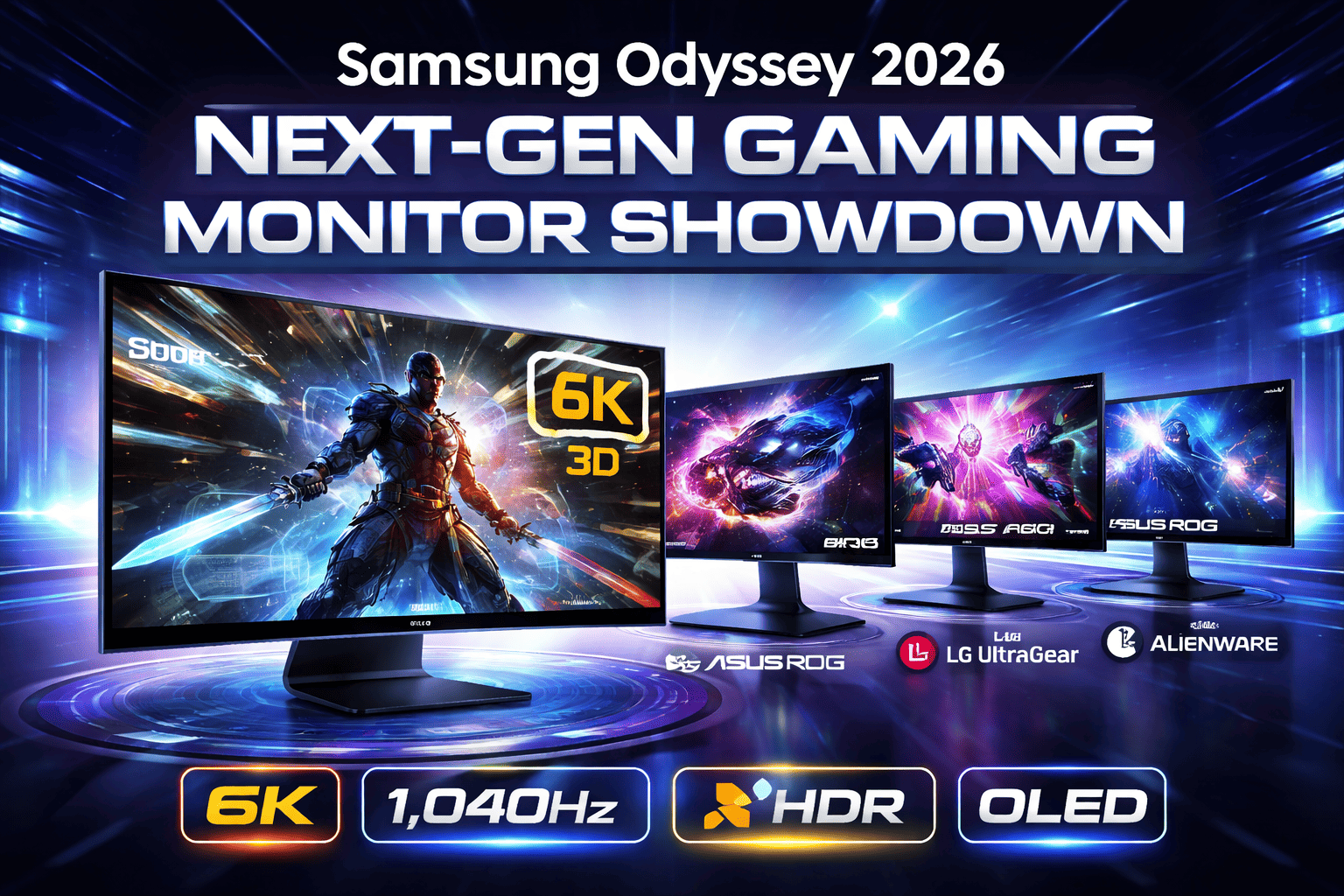
Samsung Odyssey 2026 vs. ASUS ROG, LG UltraGear, and Alienware: How the Flagships Compare
With the Samsung 2026 Odyssey lineup raising the bar in both resolution and adaptive 3D technology, it’s natural to ask how it stacks up against its main competitors in the high-end gaming monitor space: ASUS ROG, LG UltraGear, and Alienware. Each brand has historically led in specific areas—whether extreme refresh rates, OLED technology, or esports-focused performance—but Samsung’s latest entries combine multiple innovations that could redefine expectations.
1. Resolution and Panel Technology
| Brand / Model | Panel Type | Size | Resolution | Special Features |
|---|---|---|---|---|
| Samsung Odyssey 3D G90XH | IPS | 32” | 6,144 × 3,456 (6K) | Glasses-Free 3D, Eye Tracking, Adaptive Depth |
| Samsung Odyssey G8 32” | IPS | 32” | 6K | Dual Mode (3K 330Hz) |
| Samsung Odyssey OLED G8 | QD-OLED | 32” | 3,840 × 2,160 (4K) | HDR10+, Glare-Free, USB-C 98W |
| ASUS ROG Swift PG32UQX | IPS Mini-LED | 32” | 4K (3,840 × 2,160) | NVIDIA G-Sync Ultimate, HDR1400, 144Hz |
| LG UltraGear 32GQ950-B | Nano IPS | 32” | 4K UHD | 160Hz, 1ms GTG, HDR600, FreeSync Premium Pro |
| Alienware AW3423DW | OLED (QD-OLED) | 34” | 3,440 × 1,440 (UWQHD) | 175Hz, G-Sync Ultimate, Wide Color Gamut |
Analysis: Samsung leads in raw resolution, particularly with the 6K IPS panels on the Odyssey 3D G90XH and G8, while OLED variants offer deeper contrast. ASUS focuses on HDR peak brightness and G-Sync certification, LG prioritizes high refresh 4K UHD performance, and Alienware emphasizes ultrawide immersive gameplay with OLED color depth.
2. Refresh Rates and Dual Mode vs. Competitors
| Brand / Model | Native Refresh | Dual / Boost Mode | Motion Clarity Notes |
|---|---|---|---|
| Samsung Odyssey 3D G90XH | 165Hz | 3K 330Hz | 1ms GTG, adaptive 3D for games |
| Samsung Odyssey G6 | 600Hz | 1,040Hz (HD Dual Mode) | Extreme esports optimization |
| ASUS ROG Swift PG32UQX | 144Hz | OC up to 160Hz | G-Sync Ultimate reduces tearing, designed for high-frame gaming |
| LG UltraGear 32GQ950-B | 160Hz | N/A | 1ms GTG, FreeSync Premium Pro, consistent high-speed motion |
| Alienware AW3423DW | 175Hz | N/A | OLED pixel response ensures virtually no ghosting or blur |
Analysis: Samsung’s dual-mode approach stands out. While competitors offer high refresh rates, only Samsung allows a dynamic switch between high resolution and ultra-fast refresh, enabling the same monitor to serve both cinematic and competitive gaming needs. For esports-specific play, the Odyssey G6’s 1,040Hz Dual Mode is unmatched.
3. Adaptive and Immersive Features
| Feature | Samsung Odyssey | ASUS ROG | LG UltraGear | Alienware |
|---|---|---|---|---|
| Glasses-Free 3D | ✅ (G90XH) | ❌ | ❌ | ❌ |
| Eye Tracking / Adaptive Depth | ✅ | ❌ | ❌ | ❌ |
| HDR Support | HDR10+ | HDR1400 | HDR600 | HDR400+ wide gamut |
| FreeSync / G-Sync | FreeSync Premium Pro, G-Sync compatible | G-Sync Ultimate | FreeSync Premium Pro | G-Sync Ultimate |
| USB-C PD | 98W (OLED G8) | ❌ | ❌ | ❌ |
Analysis: Samsung clearly emphasizes adaptive intelligence—eye tracking and glasses-free 3D—features entirely absent from competitor offerings. HDR support is competitive, with ASUS delivering higher peak brightness, but Samsung’s HDR10+ implementation in OLED and IPS variants balances immersive visuals with gaming adaptability. USB-C power delivery further expands workflow integration for hybrid users.
4. Target Use Case Comparison
| Monitor | Target Gamer | Strengths | Limitations |
|---|---|---|---|
| Samsung Odyssey 3D G90XH | Immersion & AAA gaming | 6K 3D, adaptive depth, Dual Mode | High GPU requirements, software-dependent 3D content |
| Samsung Odyssey G6 | Esports / Competitive | Extreme refresh (600–1,040Hz), minimal latency | Not optimized for cinematic visuals |
| ASUS ROG Swift PG32UQX | High-end HDR / console gaming | HDR1400, G-Sync Ultimate, mini-LED | Lower refresh rate for esports |
| LG UltraGear 32GQ950-B | Fast-paced PC gaming | 160Hz 4K, low response | No adaptive 3D or eye tracking |
| Alienware AW3423DW | Ultrawide immersive gaming | OLED contrast, color depth | Lower resolution than Samsung 6K; ultrawide not for everyone |
Analysis: Samsung is uniquely multi-purpose, offering monitors for immersive AAA gaming (Odyssey 3D), extreme competitive play (Odyssey G6), and high-contrast OLED experiences (Odyssey OLED G8). ASUS, LG, and Alienware remain specialized, excelling in HDR brightness, ultrawide immersion, or motion clarity—but without the adaptive intelligence Samsung provides.
5. Price and Market Positioning (Projected / Observed)
| Brand / Model | Expected Price (USD) | Notes |
|---|---|---|
| Samsung Odyssey 3D G90XH | $2,499+ | Premium 6K 3D, adaptive eye tracking |
| Samsung Odyssey G6 | $1,199+ | Esports-focused, ultra-high refresh |
| Samsung Odyssey OLED G8 | $1,799+ | HDR OLED, multi-use |
| ASUS ROG Swift PG32UQX | $1,999 | Mini-LED HDR flagship |
| LG UltraGear 32GQ950-B | $1,299 | High refresh 4K IPS |
| Alienware AW3423DW | $1,099 | Ultrawide OLED gaming |
Analysis: Samsung positions its lineup at the premium end, reflecting cutting-edge features and high-resolution panels. ASUS matches in HDR mini-LED performance, LG emphasizes competitive 4K refresh, and Alienware provides unique ultrawide OLED value. In practical terms, Samsung offers feature density and adaptive flexibility that competitors cannot match at the same resolution scale.
6. Final Comparative Observations
- Innovation: Samsung leads with glasses-free 3D, eye tracking, and dual-mode refresh, delivering experiences competitors cannot replicate.
- Esports Capability: Odyssey G6’s 1,040Hz Dual Mode is unmatched, though Alienware and LG remain strong in high-refresh ultrawide/4K categories.
- Immersion & HDR: OLED panels from Samsung and Alienware provide deep contrast, while ASUS pushes HDR peak brightness.
- Flexibility: Only Samsung offers true adaptability between cinematic AAA gaming, competitive esports, and hybrid workflows (via USB-C).
- Value Proposition: Samsung’s high-end pricing is justified by unique technology; competitors remain compelling for specific niches but lack broad adaptability.
Final Thoughts
As the gaming monitor market heads into 2026, the playing field is becoming richer and more complex than ever—driven not just by raw specs, but by how displays interact with players and content. What once was measured primarily by pixel count and refresh numbers has evolved into a multifaceted ecosystem where adaptability, visual intelligence, and use‑case flexibility carry almost as much weight as sheer performance.
Samsung’s 2026 Odyssey lineup encapsulates this shift. With the Odyssey 3D G90XH, Samsung isn’t merely increasing resolution or boosting refresh rates—it’s introducing a fundamentally different way to experience visual depth through glasses‑free 3D and eye tracking. While its long‑term adoption will hinge on developer support and comfort in extended sessions, the ambition behind it is unmistakable and unmistakably forward‑looking.
Meanwhile, the Odyssey G6’s dual‑mode refresh strategy elegantly bridges the divide between competitive esports and everyday gaming. Reaching a theoretical 1,040Hz refresh rate is more than a marketing number—it’s a statement about where competitive hardware is headed. At the same time, Samsung’s OLED offerings demonstrate that it understands the demand for deep contrast and cinematic visuals without compromising responsiveness.
Against this backdrop, long‑standing players such as ASUS ROG, LG UltraGear, and Alienware maintain strong relevance. ASUS continues to push HDR peak brightness and local dimming sophistication, making it a top choice for HDR enthusiasts and console players. LG’s high‑refresh 4K IPS panels strike a compelling balance between clarity and competitive performance. Alienware’s QD‑OLED ultrawide models pair deep contrast with immersive aspect ratios, catering to fans of narrative‑driven, atmospheric games.
But when viewed holistically, Samsung’s latest Odyssey lineup stands out for its breadth of innovation. Not every gamer needs glasses‑free 3D or extreme refresh capabilities, but the fact that a single manufacturer is delivering both—alongside a range of high‑contrast OLED and high‑speed IPS options—marks a meaningful evolution in how gaming monitors are conceived and marketed.
In essence:
- If you want cutting‑edge immersion and future‑oriented display tech → Samsung Odyssey 3D leads.
- If you’re a competitive gamer chasing lowest latency and highest refresh → Samsung Odyssey G6 and LG UltraGear strike appealing tones.
- If your priority is HDR brilliance or cinematic richness → ASUS ROG and Alienware OLED/mini‑LED options remain compelling.
Looking ahead, the next wave of gaming hardware integration—spanning GPUs, consoles, VR/AR, and AI‑driven rendering—will continue to shape what monitors are capable of. What’s clear today is that the battle for visual supremacy is no longer about peak numbers alone; it’s about how seamlessly displays adapt to both the content being shown and the person looking at it.
And with that, gaming monitors are finally evolving from static canvases into intelligent partners in play—which, for gamers and creators alike, is an exciting horizon to reach.