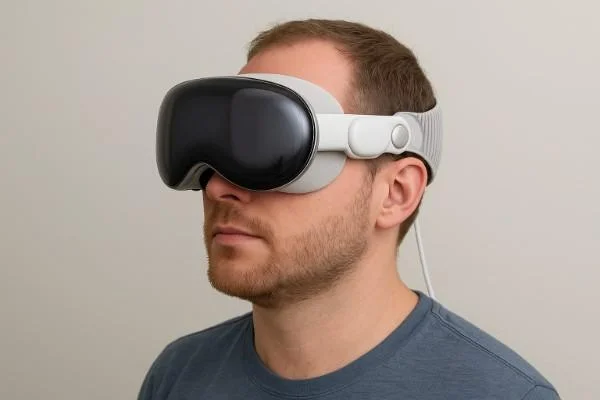
Apple’s second-generation Vision Pro headset — now powered by the new M5 processor — refines nearly every part of the company’s mixed-reality experiment. It’s lighter on the face, more responsive to movement, and slightly longer-lasting than its predecessor. Yet despite the polish, the same question that haunted the first Vision Pro lingers: What exactly is this device for — and who is it for?
A More Comfortable, Better-Balanced Headset
When Apple unveiled the Vision Pro M5, most of the immediate attention fell not on its chip, but on its new Dual Knit Band. The redesigned head strap adds a second tension point over the crown and includes small counterweights that balance the headset’s front-heavy body. It’s a subtle but important fix. Early adopters of the original Vision Pro complained about discomfort during long sessions, especially when watching movies or working across multiple floating windows.
This time, Apple’s engineers seem to have listened. The new strap — which also fits the first-generation model — tightens in two directions through a single knob system that adjusts both top and rear bands. It makes the headset feel steadier without adding much bulk. Retailing separately for $99, the accessory has already become a quiet hit among early users.
M5 Brings Speed, Efficiency, and Sharper Motion
Under the hood, the M5 chip delivers what Apple calls a “generational leap” in processing efficiency. In real use, the improvements are evolutionary rather than revolutionary. The micro-OLED displays now refresh at 120Hz, up from 100Hz in the M2 version, reducing motion blur and enhancing clarity while scrolling or navigating virtual workspaces.
Battery performance is modestly better as well. Apple claims up to three hours of video playback or about two and a half hours of general use — gains of roughly 10–15 percent over the first Vision Pro. In testing, users could stream several episodes of a TV show before hitting the low-battery warning. Still, the tethered battery pack remains an unavoidable reminder that this headset is not yet truly mobile.
Still the Best, Still Isolating
Few dispute that the Vision Pro remains the most advanced mixed-reality headset available. Competing devices from Meta, Sony, and HTC have struggled to match its display quality or seamless software ecosystem. Apple’s integration with macOS, iCloud, and iOS remains a technical triumph.
Yet for all the engineering brilliance, many users describe the same emotional experience: isolation. The Vision Pro creates a world so immersive that it becomes solitary. “It’s magical, but it’s lonely,” one early adopter told Tech Analysis Desk. Even with enhanced personas — the realistic 3D avatars used for FaceTime and collaboration — most owners find few others to interact with. At $3,499, it’s a device that exists in a niche of its own making.
Photos, Movies, and Moments of Wonder
The most powerful moments in the Vision Pro M5 still come from its ability to recreate memory. Using on-device AI, the M5 can convert standard 2D images into spatial photos, turning family portraits into living scenes with subtle depth and movement. The process is now faster, taking only seconds.
Users describe it as almost emotional — a way to “step back into time.” Photos and 3D videos recorded through the Vision Pro or compatible iPhones bring faces and moments to life with striking realism. The effect, while still slightly uncanny, remains one of Apple’s most compelling demonstrations of immersive technology.
Movies also shine. Watching a blockbuster inside the Vision Pro’s massive virtual theater feels cinematic and precise, aided by spatial audio that replicates surround sound. Apple’s curated library of immersive shorts — nature documentaries, sports clips, and travel experiences — continues to grow, though users say it’s still too limited. Full-length features and major streaming releases remain confined to traditional 2D playback, albeit on a virtual screen that can stretch to the size of a movie hall.
Widgets, Work, and the “Spatial Computer” Pitch
In its marketing, Apple insists the Vision Pro is not a VR headset but a spatial computer. The company wants users to see it as a productivity tool as much as an entertainment device. The M5 update reinforces that vision with smoother multitasking, refined hand and eye tracking, and new support for widgets that can be anchored to real-world locations.
Pinned widgets — such as clocks, music controls, or photos — now remain floating in space between sessions, allowing users to create personalized digital environments within their homes. For work, the headset connects to a Mac to display a massive virtual monitor, making multitasking and text editing surprisingly natural.
Yet practical limitations persist. While typing, editing, and browsing the web are possible, they rarely feel easier than on a MacBook or iPad. Extended wear leads to eye and neck fatigue. And for all its promise as a productivity device, collaboration remains Apple’s weakest link. With so few Vision Pro owners, there’s simply no network effect.
The Promise and Problem of Passthrough
Apple’s passthrough technology, which shows the outside world through high-resolution cameras, remains a marvel — but an imperfect one. The M5’s improved image processing makes it slightly sharper, but users still report a faint blur that breaks the illusion of reality. It’s good enough for checking a phone or reaching for coffee, but not yet natural enough for meaningful face-to-face interaction.
That limitation highlights a larger truth: despite Apple’s insistence that Vision Pro blends the physical and digital worlds, it still feels like stepping away from real life. Conversations, pets, and even small gestures — like rubbing your eyes or scratching your nose — remind you that there’s glass between you and everything else.
A Platform Waiting for Its Purpose
The Vision Pro M5 is, in many ways, a marvel of engineering. But it also reveals the gap between technological capability and human need. As one analyst put it, “Apple built the future — but forgot to ask why.”
With the M5, Apple appears to be refining rather than reinventing. The company’s roadmap suggests a smaller, lighter headset could arrive in 2026, potentially at a lower price. Meanwhile, Apple is betting on live sports and entertainment to give Vision Pro owners a reason to return. The company plans to stream NBA games in 3D, promising courtside immersion that could finally justify the price.
Until then, the Vision Pro M5 stands as a device without a true category: not quite a gaming system, not yet a daily computer, and too expensive to be a casual media viewer.
The Verdict
Apple has solved many of the first model’s ergonomic and performance complaints, but the deeper challenge — how to make mixed reality feel social, necessary, and natural — remains. The Vision Pro M5 is a remarkable piece of hardware searching for a habit.
It’s not that the headset fails; it’s that it succeeds in isolation.